

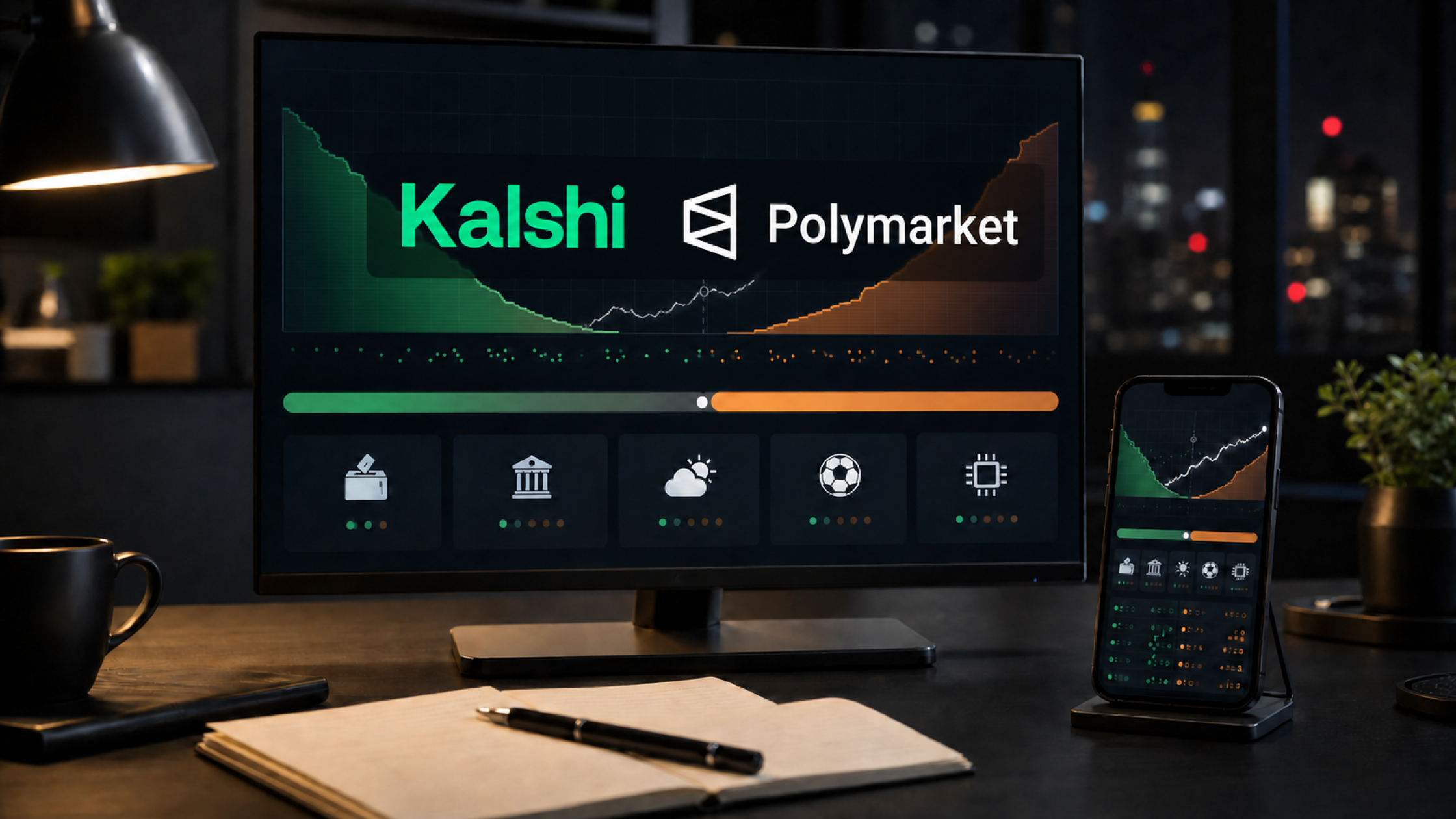
Prediction markets in one minute
A prediction market lets people trade contracts tied to the outcome of a future event. The question might be whether a central bank will cut rates, who will win an election, or whether a temperature threshold will be reached. The market price reflects the collective view of participants at that moment.
That price is not a guaranteed forecast. Rules, liquidity, fees, legal status and user protections vary by platform and country, so the contract terms matter as much as the headline probability.
Prediction-market odds now appear regularly in coverage of politics, economics, technology and sport. Some readers use them as another signal when assessing an event. Others trade because they believe the market is mispricing the outcome.
The key difference from a survey is that participants commit money or another asset of value. Someone who thinks an outcome is underpriced can buy “Yes”; someone who believes the market is too optimistic can take the opposite side. As orders meet, the price adjusts continuously.
The apparent simplicity of a Yes-or-No contract can hide important details. A trader can predict the event correctly and still lose money after paying too much, fail to exit when liquidity disappears, or misunderstand the resolution rules. Prediction markets are useful information tools, but they are not crystal balls.
What is a prediction market?
A prediction market is a marketplace for contracts whose value depends on an event that has not yet happened or has not yet been officially resolved. The most familiar format asks a binary question: will a defined event occur before a stated deadline?
At settlement, the winning contract receives the value specified in the rules while the losing contract may settle at zero. In a simple market where a winning share pays 1 unit, a Yes share is worth 1 if the event occurs and 0 if it does not.
Markets can cover many subjects, including:
- elections and political events;
- inflation, employment data and interest-rate decisions;
- weather and natural events;
- sports results;
- film revenue, awards and entertainment;
- product launches and technology milestones; and
- digital-asset prices and crypto-related events.
This gives prediction markets two roles. They provide a way to trade event risk, and they aggregate many individual views into a single market price.
How prediction markets work
Interfaces differ, but most markets follow the same five stages:
- Define the question. The event, deadline and qualifying conditions must be clear.
- Name the resolution source. The rules specify which official announcement, data provider or governing body will determine the result.
- Open trading. Buyers and sellers submit orders, allowing prices to move with supply and demand.
- Close the market. Trading ends at the time stated in the contract, which may be before or shortly before the event.
- Resolve and settle. Once the result is confirmed, the platform pays contracts according to the written rules.
A position does not always have to be held until settlement. If the market remains open and there is a buyer, a trader can sell earlier. The profit or loss then comes from the difference between the entry and exit prices rather than the final outcome alone.
A simple example
Assume a Yes contract trades at 0.65 units and pays 1 unit if the event occurs.
| Item | Example |
|---|---|
| Number of contracts | 100 |
| Purchase price | 0.65 units each |
| Initial cost | 65 units before fees |
| If Yes wins | 100 units returned; 35-unit gross profit |
| If No wins | The contracts settle at 0; the purchase cost is lost |
Being right does not automatically mean earning a large return. If a trader buys close to 1, little upside remains. A low-priced contract offers more potential upside, but its price also shows that the market considers the outcome less likely.
How prices become probabilities
When a winning contract pays 1 unit, a Yes price of 0.65 is often read as an implied probability of roughly 65%. New information that supports the event may attract buyers and move the price to 0.75 or 0.80.
Implied probability is a market estimate, not a proven fact. It can be distorted by:
- a small or unrepresentative group of participants;
- low liquidity, where a few orders move the price sharply;
- a wide bid-ask spread;
- fees and position limits;
- unequal access to information;
- attempts to influence the displayed price; or
- ambiguous contract wording.
Displayed Yes and No prices may not add to exactly 1, particularly when the interface shows prices from opposite sides of the order book. To judge the quality of a signal, look at trading volume, available orders and the spread, not only the large percentage on the screen.
Who decides the outcome?
Resolution rules are as important as choosing the right side. A contract pays according to its written definition, not according to what participants feel “obviously happened.”
Centralized platforms usually name the source and settlement process in advance. Blockchain-based platforms may use an oracle process that allows an outcome to be proposed, challenged during a dispute window and finalized through the system’s rules.
Before buying, check four details:
- Exact wording. “Announced,” “signed,” “takes effect,” “wins” and “is certified” can refer to different moments.
- Date, time and time zone. Confirm whether a deadline means the start or end of a day.
- Primary source. Identify the agency, website, league or publisher used for settlement.
- Exceptional cases. Read what happens after a delay, withdrawal, tie, correction or missing announcement.
You can predict the event correctly and still lose under the rules
If a contract asks whether a law will “take effect” by a deadline, a bill that passes parliament but has not yet entered into force may still resolve as No. Always trade the contract definition, not the shorter headline.
Common prediction-market structures
Binary markets
The contract settles to Yes or No. This is the easiest structure to read as an implied probability.
Multiple-choice markets
Several mutually exclusive outcomes are listed, such as candidates in an election or winners of an award. The combined displayed prices may exceed or fall below 100% because of spreads and liquidity.
Range markets
The outcome is divided into intervals, such as an inflation reading or a price ending within a stated band.
Numeric or scalar markets
The payoff depends on a measured value rather than a simple binary result. These markets require particularly careful reading of the settlement formula.
Platforms also differ in how orders are matched. Some use an order book, others use an automated market maker, and some combine several mechanisms. That choice affects spreads, slippage and the ease of entering or leaving a position.
How prediction markets differ from polls, stocks and gambling
| Comparison | Main difference |
|---|---|
| Opinion poll | A poll records stated answers from a sample. A prediction market produces a price from participants who accept financial consequences. |
| Stock market | A share represents ownership or a claim linked to a business. An event contract normally expires after a defined outcome. |
| Sportsbook or bookmaker | A bookmaker typically sets odds and acts as the counterparty. An exchange-style market lets participants trade with one another, although the legal classification still depends on the jurisdiction and contract. |
| Futures and options | Both can express views on future outcomes, but prediction contracts often settle on a discrete event rather than the price of an underlying asset. |
Labels do not determine legal status. The same product may be treated as a derivative in one country and as gambling or an unauthorized service in another.
Why prediction markets are attracting attention
Prices update quickly when new information arrives, are easy to quote, and compress many competing views into one number. This makes them appealing to journalists, analysts and readers who want to see how expectations are changing.
They can also reward people who identify information the market has missed. In theory, that incentive encourages participants to research a question and correct obvious mispricing. Organizations have also experimented with internal markets to forecast deadlines, sales or project outcomes.
Crypto infrastructure has expanded the range of blockchain-based markets and made cross-border access technically easier. It has also introduced additional risks involving wallets, smart contracts, oracles, stablecoins and network fees.
Risks to understand before trading
1. The entire position can be lost
A losing contract may settle at zero. A confident forecast is not a reason to risk money that cannot be lost.
2. Thin liquidity can trap a position
A displayed price does not guarantee that a large order can be filled there. Limited depth can create slippage or make an early exit impossible.
3. Contract wording may be misunderstood
Deadlines, time zones, official sources and exceptional cases can change the outcome. The full rulebook controls settlement.
4. Market prices can be wrong
Participants may share the same bias or act on the same incorrect information. A liquid market can still make a poor forecast.
5. Manipulation and ethical concerns
A participant may trade to influence the public signal rather than to earn a return. Markets involving disasters, conflict or personal safety can also raise serious ethical questions.
6. Platform and technology risk
Centralized services carry custody, account-freeze and operational risks. Blockchain systems add smart-contract, oracle, stablecoin and wrong-network transaction risks.
7. Access and regulation can change
A platform available in one country may be unavailable in another. Trying to bypass geographic restrictions can breach the terms of service and create withdrawal or account risks.
8. Fees and tax matter
Trading fees, withdrawal charges, network fees, spreads and tax can materially reduce the apparent return, especially when positions are traded frequently.
What users in Thailand should know
Reading prediction-market prices and depositing money to trade are two different activities. The first can be used as one input in research. The second exposes the user to financial, platform and legal risks.
A foreign licence does not automatically mean that a platform is authorized in Thailand. Calling a product an “event contract,” or settling it with crypto or a stablecoin, does not by itself place it under Thai investor-protection rules.
Information published by Thailand’s SEC in 2026 explained that event contracts offered by overseas prediction markets do not necessarily have the same character as futures contracts regulated under Thai law. Paying with a digital asset also does not automatically bring the contract under Thailand’s digital-asset protections.
Thai authorities have previously taken enforcement positions against certain prediction platforms as online gambling. Users should therefore check the latest information from Thai authorities and the platform’s geographic terms before making a transaction. Using a VPN or false information to bypass a restriction can breach platform rules and make it harder to recover funds.
Key points for users in Thailand
- Foreign regulation is not the same as permission to operate in Thailand.
- Crypto settlement does not automatically create Thai SEC protection.
- Local complaint or recovery channels may be limited if a dispute occurs.
- Check current legal, tax and platform terms before committing funds.
This is general information, not legal, investment or tax advice. For a significant transaction or a business decision, consult a professional familiar with the relevant Thai and overseas rules.
Checklist before trusting a price or buying a contract
- Read the full question, not only the shortened market title.
- Confirm the deadline and time zone.
- Read the resolution source, authority and dispute process.
- Check volume, order-book depth and the bid-ask spread.
- Treat the percentage as a market view, not a guarantee.
- Calculate the return after all fees and charges.
- Assume that an early exit may not be available.
- Check whether the service is available to users in your country.
- Review the operator, regulatory status, custody model and dispute history.
- Use the official website and remain alert to wallet-draining phishing pages.
Frequently asked questions
Is a prediction market gambling or investing?
There is no universal answer. The legal treatment depends on the contract structure, licence and jurisdiction. Some event contracts are regulated as derivatives; others may be treated as gambling.
Does a price of 70 mean a 70% chance?
It can be read as an implied probability of roughly 70% when a winning contract pays 100 units. It is still a market estimate affected by liquidity, spreads, fees and participant behaviour.
Must a contract be held until settlement?
Not always. A trader may sell early while trading remains open, but only if another participant is willing to take the order at an acceptable price.
Does predicting the winner guarantee a profit?
No. Profit depends on the purchase price, sale or settlement value and costs. Buying the correct side at a very high price can leave little upside.
Are Polymarket and Kalshi the same?
No. Both offer event-based markets, but their corporate structures, technology, custody arrangements, resolution processes, regulation and geographic availability differ.
Is Robinhood Prediction Markets available in Thailand?
Robinhood states that event-contract customers need an approved derivatives account and must be US residents, with availability still varying by state. It is not a general service for residents of Thailand.
Are prediction markets always more accurate than polls?
No. Some markets perform well because they combine diverse information and incentives, but accuracy can deteriorate when participation or liquidity is low or when the crowd shares the same mistaken assumption.
Do all prediction markets use blockchain?
No. Some operate as centralized exchanges, while others use smart contracts and digital assets. Blockchain is one possible architecture, not a defining requirement.
Can prediction markets be useful without trading?
Yes. Prices can be monitored as one indicator of changing expectations. They should be compared with primary sources, news, polls and other models rather than treated as the sole source of truth.
Summary: a measure of expectations, not a crystal ball
Prediction markets turn views about future events into tradable prices. Their strength is that those prices can react quickly to new information and summarize many opinions in a compact form.
The signal is only as good as the market’s rules, participation and liquidity. Anyone considering a trade must read beyond the headline percentage and be prepared for a total loss, an illiquid exit or a resolution dispute.
For users in Thailand, overseas regulation does not automatically mean local authorization or protection. Check the latest Thai rules, tax implications and platform restrictions before taking part.
Information reviewed on 25 August 2026. This article is for general education and is not investment, legal or tax advice. Rules and platform availability can change.
Conclusion
Understand how prediction markets turn future events into tradable contracts, how prices become implied probabilities, how outcomes are resolved, and which risks and Thai legal considerations users should review.


Share:
Forgot Your YubiKey PIN? How to Reset FIDO2 and What You Lose
What Is the CLARITY Act? The U.S. Senate's September 15 Vote Explained