

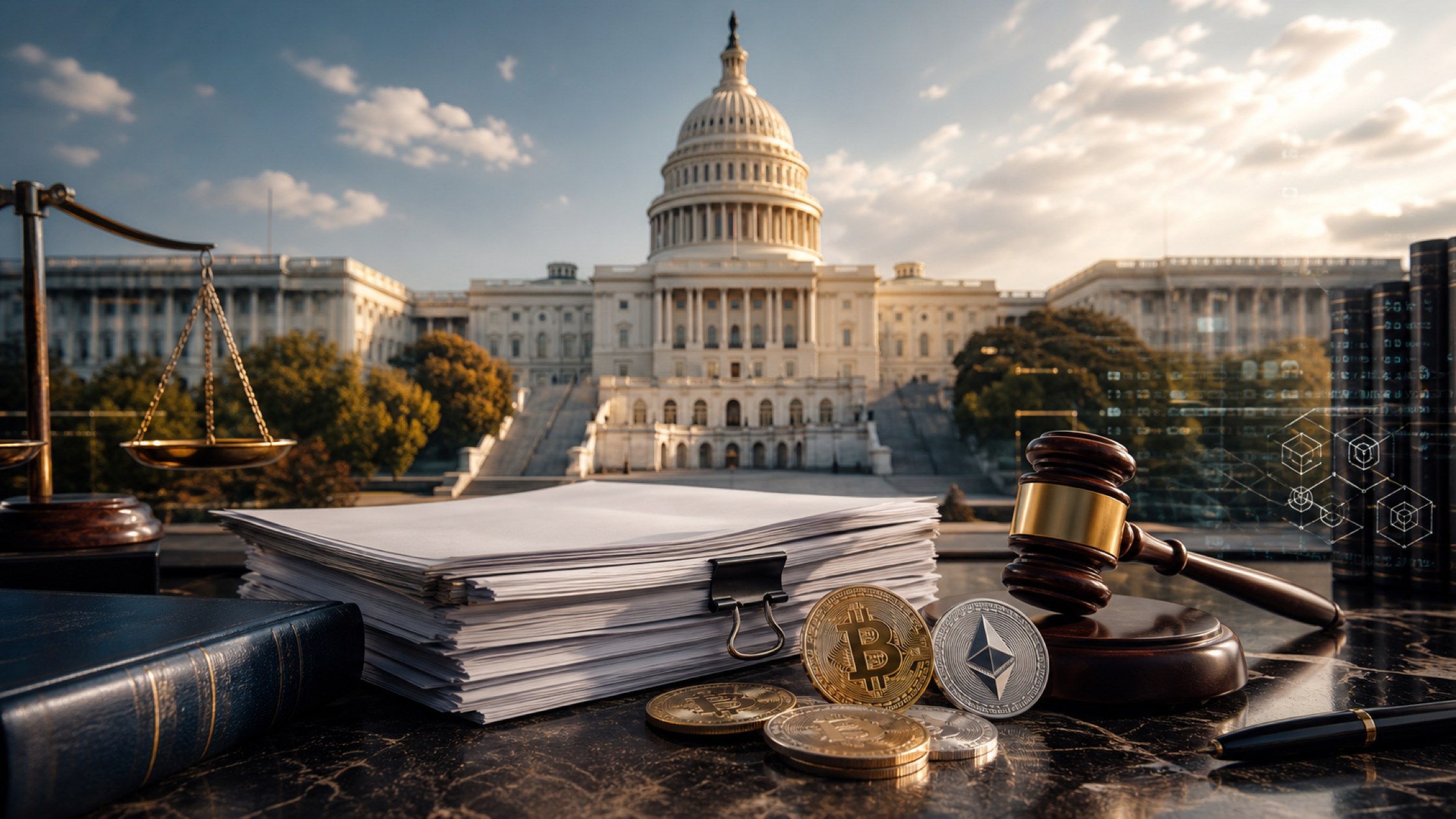
The CLARITY Act in one minute
The CLARITY Act is a U.S. digital asset market-structure bill. It aims to draw a clearer line between the Securities and Exchange Commission, which oversees securities, and the Commodity Futures Trading Commission, which oversees commodity and derivatives markets. It also sets proposed rules for trading platforms, brokers, dealers, custodians and token issuers.
As of 25 August 2026, the bill has not passed the Senate and is not law. The Senate majority leader has filed cloture on the motion to proceed, with a procedural vote scheduled for 15 September 2026. Even if that vote succeeds, debate, amendments and a final vote on the substance would still remain.
For years, the U.S. crypto market has operated around the same unresolved questions: when is a digital asset a security, when is it a commodity, and which regulator should supervise the business trading or holding it? That uncertainty affects more than U.S. companies. Global exchanges, investors and blockchain projects all adjust their products when they need access to American users or capital.
The CLARITY Act is therefore not just an argument about whether the SEC or CFTC should have the larger role. The proposal reaches token issuance, secondary trading, customer-asset custody, anti-money-laundering requirements, decentralised finance, self-custody and certain rewards linked to payment stablecoins.
Where the CLARITY Act stands as of 25 August 2026
| Date | Development | Why it matters |
|---|---|---|
| 17 July 2025 | The House passed H.R. 3633 by 294 votes to 134. | The House version received support from members of both parties. |
| 14 May 2026 | The Senate Banking Committee approved its bill by 15 votes to 9. | The proposal cleared a major committee, but not the full Senate. |
| 22 July 2026 | Revised text combining work from the Banking and Agriculture committees was released. | The framework became broader across both securities law and CFTC-regulated digital commodity markets. |
| 7-8 August 2026 | The majority leader filed cloture on the motion to proceed. | This placed a procedural decision on the Senate calendar. |
| 15 September 2026 | A procedural vote is scheduled for 2:15 p.m. Washington time. | It is not a final vote to enact the bill. |
The distinction matters. The September 15 vote concerns cloture on the motion to proceed. In practical terms, senators are deciding whether to move the bill into consideration, not whether to approve the final statutory text. If cloture succeeds, debate, amendments and later votes would follow.
What is the CLARITY Act?
The bill's full name is the Digital Asset Market Clarity Act. Its central purpose is to establish a federal market-structure framework for digital assets and reduce the grey area created when securities and commodities laws written for traditional markets are applied to blockchain networks.
The proposal does not classify an asset solely by the label chosen by its issuer. It looks at the nature of the asset, how it was offered, the rights attached to it, the role of the development team and the extent to which value still depends on a person or managerial group.
The Senate text uses an ancillary asset concept for assets whose value remains tied to a developer's or manager's efforts. A token may be treated as a commodity for some purposes while fundraising transactions and disclosure obligations remain within the SEC's sphere.
Why Congress is pursuing market-structure legislation
The SEC and CFTC were created with different mandates. The SEC supervises securities issuance and trading. The CFTC oversees commodity and derivatives markets. Many digital assets do not fit neatly into either legacy category.
Bitcoin is commonly treated as the clearest example of a digital commodity. Tokens sold to fund a project, build a network or grant economic rights can look more like securities. A network can also evolve: an asset that once depended heavily on a small development team may become less reliant on that group as the network matures.
Without a clear statutory boundary, businesses often discover the regulator's view through enforcement action or litigation. Supporters of the CLARITY Act argue that written rules would allow firms to know where to register, what to disclose and how customer assets must be protected before entering the market.
The main provisions
1. More detailed digital asset categories
The proposal distinguishes digital securities, digital commodities, assets connected to investment contracts, payment stablecoins and tokenised versions of traditional securities. It does not place every blockchain-based asset in a single legal bucket.
2. Disclosure duties for developing networks
Certain projects would provide initial and semi-annual disclosures while a network's value still depends materially on founders or developers. Once that managerial role has ended, the project or service provider may seek certification to terminate some continuing disclosure duties.
3. A Regulation Crypto fundraising route
The bill proposes an SEC registration exemption called Regulation Crypto. Eligible projects could raise public capital within specified limits and disclosure requirements, while restrictions on insider resales are intended to reduce dumping and manipulation risks.
4. Registration of exchanges, brokers and dealers
Businesses acting as digital commodity exchanges, brokers or dealers would enter a formal regulatory framework. Requirements would cover risk management, disclosures, customer treatment and compliance with anti-money-laundering and transaction-monitoring laws.
5. Customer assets in insolvency
Some assets held for customers would be treated as customer property in bankruptcy proceedings. Service providers would also disclose how different assets are expected to be treated if the firm becomes insolvent.
6. Limits on passive stablecoin yield
The July text would prevent service providers from paying U.S. customers interest or yield merely for holding a payment stablecoin. Activity-based rewards could remain possible, including incentives tied to transactions, liquidity provision, staking, governance participation or loyalty programmes, provided they are not designed to function as deposit interest.
7. Tokenised securities remain securities
Recording a share, bond or fund interest on a blockchain does not erase its existing legal character. A tokenised security would remain subject to securities law according to the underlying instrument.
How SEC and CFTC responsibilities would differ
| Regulator | Primary role under the proposed framework |
|---|---|
| SEC | Digital securities, investment-contract transactions, fundraising, disclosure obligations and intermediaries carrying out securities-market activities. |
| CFTC | Digital commodities, regulated spot trading and digital commodity exchanges, brokers and dealers. |
| Shared rulemaking | Connected subjects such as mixed-asset accounts, portfolio margin, definitions and the transition between regulatory regimes. |
The framework is not a simple handover of crypto from the SEC to the CFTC. The transaction used to raise funds can remain within securities law even when the token later trades as a digital commodity. The bill attempts to separate the investment contract from the asset that may circulate after the original fundraising transaction.
DeFi, developers and self-custody
The proposal distinguishes genuinely decentralised systems from arrangements that still have an identifiable controller. Factors include whether a person can alter, pause or screen protocol activity. Meaningful control can bring that person within rules that apply to financial intermediaries.
At the same time, developers who write or publish software without taking custody of user funds would receive protection from being treated as money transmitters merely for building tools or processing network activity. That protection would not cover a person who knowingly helps transfer criminal proceeds.
The bill also says federal agencies should not prohibit or restrict individuals from using self-custody wallets. Existing powers involving money laundering, terrorist financing, sanctions and financial crime would remain in force.
A right to self-custody is not immunity from the law
Users would still have to comply with applicable law, while businesses that transmit or hold assets for customers could continue to face monitoring and reporting duties based on their role.
If you would rather hold your assets yourself than leave them on a platform, see every hardware wallet SIAMBC stocks.
The case for and against the bill
Supporters see a long-awaited rulebook
- a clearer division between SEC and CFTC authority;
- greater incentive for businesses and developers to operate under U.S. law;
- defined duties for platforms and customer-asset custody;
- stronger tools for anti-money-laundering, fraud and cybersecurity controls; and
- a framework that accommodates new technology without copying every rule from traditional markets word for word.
Critics argue that important gaps remain
Minority members of the Senate Banking Committee identified five broad concerns: gaps in securities-law coverage, illicit finance, systemic and taxpayer risk, political conflicts of interest, and the strength of consumer and investor protections.
The debate is therefore not simply whether the United States needs legislation. It is whether the proposed boundary would bring digital asset businesses into an effective regulatory system or allow some transactions to leave securities law too easily.
Banks have also focused on payment-stablecoin rewards. If a stablecoin service can offer returns similar to deposits, funds could move out of banks and reduce a source of lending capital. The latest text tries to distinguish passive interest from rewards connected to genuine user activity.
What happens next?
- 15 September 2026: the Senate votes on cloture for the motion to proceed. With full attendance, cloture generally requires three-fifths of the Senate, or 60 votes.
- If cloture succeeds: the Senate can move into consideration, debate and amendments before later votes.
- If the Senate changes the text: the House and Senate must approve identical language before the bill can be sent to the president.
- After signature: the SEC, CFTC, Treasury and other agencies would still need to issue implementing rules within the statutory timetable.
Republicans hold 53 Senate seats, so reaching 60 would require support from the other party if all senators participate and the threshold remains unchanged. Filing cloture shows that Senate leadership intends to move the proposal, but it does not prove that every stage has the votes needed to pass.
Why the bill matters outside the United States
The CLARITY Act would not change Thai law directly. The United States is, however, one of the world's largest capital markets, and global platforms often design products around U.S. regulatory access. Several effects could reach users and projects elsewhere:
- Token classifications may become clearer: global platforms could adjust listings and service terms around U.S. categories.
- Liquidity may move toward registered venues: institutions tend to favour markets with clearer custody and reporting standards.
- Asian projects may face broader disclosure expectations: projects serving, raising capital from or offering assets to U.S. users could be affected.
- Stablecoin and DeFi products may change: providers with U.S. customers could redesign rewards, interfaces and risk controls.
- Other countries may study the model: regulators elsewhere could borrow parts of the framework without adopting it in full.
For readers following the news, the most useful discipline is to separate a procedural Senate vote from final passage. Agreeing to begin consideration, passing the Senate, reconciling identical text in both chambers and becoming law are distinct steps.
Frequently asked questions
Has the CLARITY Act become law?
No. The House has passed its bill and the Senate Banking Committee has approved a version, but the full Senate process and other legislative steps remain.
When is the next Senate vote?
The congressional schedule lists a cloture vote on the motion to proceed for 15 September 2026 at 2:15 p.m. Washington time. Political schedules can change, so the timing should be checked again closer to the date.
Is the September 15 vote a final vote on the bill?
No. It is a procedural vote concerning whether the Senate should move into consideration. Passage would open the path to debate and later votes on the substance.
Would every crypto asset become a commodity?
No. Digital securities, investment-contract transactions and tokenised securities would remain within securities law. The framework uses classifications and disclosure obligations to distinguish among cases.
What would it mean for Bitcoin?
Bitcoin is commonly treated as the clearest digital commodity. The most direct effects would therefore concern regulated spot markets, brokers, custody and market oversight rather than changing Bitcoin's basic classification.
Would the bill prohibit self-custody wallets?
No. The July text protects individuals' ability to use self-custody wallets, while preserving laws concerning money laundering, sanctions, terrorist financing and criminal activity.
Is the CLARITY Act the same as the GENIUS Act?
No. The GENIUS Act focuses on payment-stablecoin regulation. The CLARITY Act is a broader market-structure proposal covering token classification, trading venues, intermediaries, DeFi and the allocation of SEC and CFTC authority.
Would it apply directly to users in Thailand?
It would not normally change rights or duties under Thai law. Global platforms and projects could nevertheless alter listings, liquidity and service conditions to comply with the U.S. framework, which can affect users in other countries.
September 15 is an important checkpoint, not the finish line
The CLARITY Act attempts to resolve a long-running U.S. problem: the absence of a clear statutory boundary between digital securities and digital commodities, alongside incomplete rules for trading platforms, intermediaries, DeFi and customer-asset protection.
Supporters want to replace regulation driven by individual enforcement cases with a rulebook that businesses can follow in advance. Critics believe the proposal could let some activity move outside securities law too easily and does not yet provide enough protection against illicit finance, conflicts and consumer harm.
The September 15 vote will test whether the bill has enough support to enter Senate consideration. Even if that hurdle is cleared, debate, amendments, a substantive Senate vote and agreement with the House would still lie ahead.
Information checked on 25 August 2026. This article provides general information and is not legal, investment or tax advice. The bill's status and Senate schedule can change.
Conclusion
A clear guide to the U.S. CLARITY Act, its proposed division of SEC and CFTC authority, and what the Senate's September 15, 2026 procedural vote does and does not mean.




Share:
What Is a Prediction Market? How It Works, Risks and What Thai Users Should Know
Crypto Tax in Thailand 2026: What Is Exempt and What Remains Taxable