

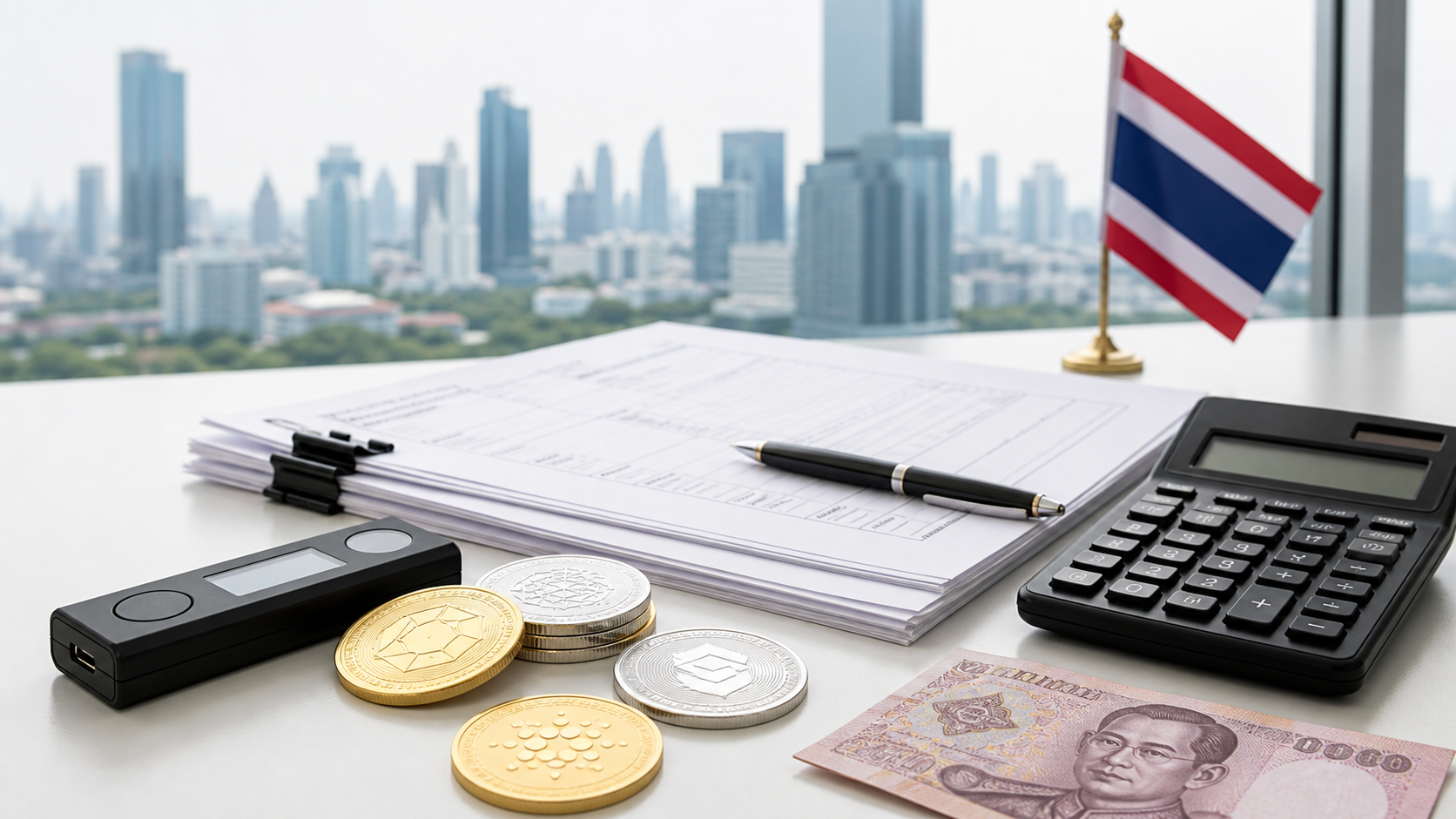
Thailand crypto tax in one minute
- Capital gains from cryptocurrency or digital-token transfers made through a Thai-licensed digital asset exchange, broker or dealer are exempt from Thai personal income tax for income received from 1 January 2025 through 31 December 2029.
- The exemption depends on the operator's Thai licence. A platform is not covered simply because Thai residents can open an account or deposit baht.
- It is not a blanket exemption for every form of crypto income. Compensation, mining income, rewards and returns earned from putting digital assets to work still need to be classified separately.
- Buying and holding does not create realised income. Moving assets between wallets that you own will also generally not create income if ownership does not change, but records should be kept.
- Transactions on overseas exchanges, decentralised venues or direct peer-to-peer markets do not automatically qualify.
“Crypto tax” sounds like a single rule, but the tax outcome depends on what actually happened. Buying an asset is different from selling it. Moving coins into your own wallet is different from transferring them to another person. Trading profit is also different from being paid in crypto, mining an asset or receiving a yield payment.
Thailand changed the treatment of qualifying capital gains from 2025. Individuals can receive an exemption when the transfer is completed through a digital asset business licensed under Thai law. The relief is significant, but it has a fixed period, a defined set of eligible operators and a limited scope. It should not be read as “all crypto is tax-free.”
Do crypto traders in Thailand still pay tax?
A capital gain realised through a digital asset exchange, broker or dealer licensed in Thailand is exempt from Thai personal income tax when the income is received between 1 January 2025 and 31 December 2029.
Other receipts can remain taxable. Salary and service fees paid in crypto retain the character of employment or business income. Mining, promotional rewards and yield-generating arrangements also need their own analysis. Trades on an overseas platform, a decentralised protocol or outside an eligible Thai operator require separate review.
The 2025-2029 capital-gains exemption
Ministerial Regulation No. 126, as amended by Ministerial Regulation No. 399, exempts the benefit arising from a transfer of cryptocurrency or digital tokens to the extent that the value exceeds the investment, provided that the transfer is made through one of the following channels:
- a licensed digital asset exchange;
- a licensed digital asset broker; or
- a transfer to a licensed digital asset dealer.
The relief applies to assessable income received from 1 January 2025 through 31 December 2029. The 2026 tax year therefore falls within the exemption period.
Check the licence, not the interface
Verify the operator and the exact licence category in the Thai SEC's register of digital asset businesses. A Thai-language website, access for Thai residents or support for baht deposits is not proof that the operator is licensed in Thailand.
The rule concerns the gain above the amount invested. It does not automatically exempt salary, service income, rewards or business receipts merely because payment happens to arrive as a digital asset.
How common transactions are treated
| Transaction | General position for 2026 |
|---|---|
| Buying and holding crypto | An unrealised increase in value is not sale income. There is no realised transfer gain simply because the market price rises. |
| Selling at a profit through a Thai-licensed operator | The qualifying transfer gain is exempt during the 2025-2029 period. |
| Selling through an overseas platform | The Thai exemption does not apply automatically. Source, tax residence and any remittance into Thailand need to be considered. |
| Swapping one crypto asset for another | A swap disposes of the original asset. A gain may be exempt if the transaction is completed through an eligible channel; otherwise the baht value and gain must be considered under the general rules. |
| Paying for goods or services with crypto | Using crypto as consideration is a transfer and can create a gain or loss. Eligibility for the exemption depends on how the transaction is carried out. |
| Moving assets to another wallet you own | If beneficial ownership does not change and nothing is exchanged, the movement will generally not create income. Keep evidence connecting both wallets to you. |
| Giving crypto to another person | Both sides can have tax considerations depending on the facts, value and relationship. The absence of a cash payment does not by itself settle the tax result. |
Crypto income that can still be taxable
1. Salary and service fees paid in crypto
Payment in digital assets does not change what the payment is for. Crypto received from an employer remains employment income, while crypto received for independent work or services is classified according to that activity. The amount is measured in baht at the time it is received, using a reliable price source applied consistently.
Once that receipt has been recognised as income, the baht value used becomes the asset's cost for a later disposal. This prevents the entire sale proceeds from being treated as new income a second time.
2. Mining
Revenue Department guidance treats the act of receiving mined coins differently from disposing of them. Tax is generally considered when the mined assets are later sold, paid, transferred or exchanged. Necessary and reasonable business expenses may be deductible when supported by records, including electricity, premises and depreciation of equipment.
The 2025-2029 exemption is drafted around qualifying transfer gains. It should not be assumed to exempt every receipt arising from a mining business. Anyone mining at commercial scale should maintain separate cost records and obtain advice based on the actual operating model.
3. Staking, liquidity and other yield arrangements
Assets received as staking rewards, liquidity incentives or yield can be income when the recipient obtains them. Their baht value on that date should be recorded. If those assets are sold later, the amount already recognised as income generally becomes their cost.
The legal character varies by product. A return on cryptocurrency, a benefit attached to a digital token and a multi-step decentralised finance transaction may not be classified in the same way. Record the date, quantity, baht value and related fees for each receipt.
4. Airdrops, referral rewards and promotions
Tokens received for completing an activity, referring users or participating in a promotion may be income once the recipient can control and use them. If the assets remain locked, cannot be transferred or are still subject to conditions, the terms need to be reviewed before fixing the recognition date.
5. Profit shares from investment tokens
Profit shares and similar benefits from holding investment tokens are subject to a specific rule. An individual may elect not to include qualifying income in the year-end calculation when 15% withholding tax has been deducted and the statutory conditions are met. This treatment is for benefits from investment tokens, not a general final-tax rule for cryptocurrency gains.
Overseas platforms and foreign-source income
The temporary exemption refers to businesses licensed under Thai digital asset law. It should not automatically be extended to overseas exchanges, decentralised venues or direct trades, even when the user lives in Thailand or originally funded the account from a Thai bank.
A person present in Thailand for 180 days or more in a tax year may be treated as a Thai tax resident. Foreign-source assessable income arising from 1 January 2024 onward can become relevant when it is remitted into Thailand. Determining whether a crypto receipt is Thai-source or foreign-source is fact-sensitive and can involve where the activity was carried on, the trading channel, wallet location and counterparties.
Converting proceeds into a fiat-linked token, routing assets through several wallets or leaving them off-bank does not automatically remove a tax obligation. Frequent users of overseas platforms should keep those records separately and retain evidence of foreign tax paid if a foreign tax credit may be available.
Calculating cost when the exemption does not apply
Revenue Department guidance accepts first-in, first-out and moving-average cost methods. Once a method is selected, it should be used consistently throughout the tax year. A different method can be adopted in a later year.
Cost can include the purchase price and substantiated acquisition expenses such as trading and transfer fees. Sale proceeds and non-cash exchanges should be converted into baht at the transaction date using platform records or another reliable price source.
A simple example
Suppose Bitcoin is acquired for THB 300,000 and related acquisition costs are THB 1,000. It is later sold for THB 380,000. The gain before applying any exemption is THB 79,000.
- If the sale occurs in 2026 through a Thai-licensed operator, the THB 79,000 qualifying gain is exempt.
- If the sale takes place through a channel outside the exemption, the THB 79,000 must be reviewed under the general tax rules, including source and remittance considerations where relevant.
Real portfolios are often more complicated, with multiple purchase lots, wallets, fees and intermediate swaps. Each disposal still needs a traceable cost calculation.
Personal income tax and VAT are separate
Thailand also provides a permanent VAT exemption from 1 January 2024 for qualifying transfers of cryptocurrency or utility tokens through licensed exchanges, brokers and dealers.
This is separate from the temporary personal income tax exemption. A sound review asks two different questions: whether VAT is exempt on the transaction, and whether the individual's income or gain is exempt from personal income tax.
Records worth keeping
Documentation remains important even when a gain is exempt. A taxpayer should be able to show when the transaction occurred, which operator handled it and why the receipt falls into a particular category.
- annual trading statements from each operator;
- baht deposit and withdrawal records;
- crypto deposit, withdrawal and swap histories;
- blockchain transaction identifiers and wallet addresses;
- evidence that sending and receiving wallets belong to the same person;
- the baht value used when compensation, rewards or yield were received;
- trading fees, equipment costs, electricity bills and other relevant expenses;
- withholding tax certificates; and
- proof of foreign tax paid where a credit may be claimed.
Download records during the year rather than waiting for filing season. Some platforms limit account-history access, and a service may later close or change its reporting tools.
Which return may be required?
A qualifying exempt transfer gain is not included in taxable personal income. Other crypto-related receipts remain reportable according to their income category.
- Individuals with income beyond employment income will commonly use form P.N.D.90.
- Individuals whose only income is qualifying employment income may use form P.N.D.91.
- Certain categories under Section 40(5) to 40(8) received during the first half of the year can also trigger a mid-year P.N.D.94 filing.
Annual returns are generally due in March of the following year. Online filing may receive an extension announced for that year, so the current Revenue Department deadline should be checked before submission.
Thai personal income tax is progressive, from 0% to 35% after eligible expenses and allowances. Applying one flat rate to a gross crypto figure will not produce the correct result for everyone.
Common misconceptions
“There is no tax until I withdraw baht to my bank.”
Not necessarily. A swap, payment for goods or receipt of a reward can create an income event while assets remain on a platform or in crypto form.
“All crypto became tax-free in 2025.”
No. The exemption is limited to qualifying transfer gains, eligible operators and a defined period. Employment, business and yield income still need to be classified separately.
“Any platform available to Thai users must be Thai-licensed.”
Availability is not a licence. Verify the operator and licence category directly with the Thai SEC.
“Every transfer to my own wallet is taxable.”
A simple change of storage, with no change in beneficial ownership and no exchange for another asset, will generally not create income. Keep the transaction trail and proof of wallet ownership.
“Crypto losses can offset any other income.”
Losses should not be deducted from salary, service fees or unrelated income without a legal basis. The treatment depends on the transaction channel, tax year and applicable income rules, particularly when gains from certain transactions are themselves exempt.
Frequently asked questions
Do I report crypto that I bought but have not sold?
An unrealised market increase is generally not sale income. Keep acquisition prices and fees for future cost calculations.
Is profit on a Thai platform tax-free?
The gain is exempt when the operator is a Thai-licensed exchange, broker or dealer, the transaction meets the statutory conditions and the income is received from 1 January 2025 through 31 December 2029.
Is withdrawing crypto to my own wallet taxable?
Generally not when it is only a change of storage and ownership remains with the same person. Keep wallet addresses, transaction identifiers and supporting ownership records.
Does exchanging Bitcoin for another token count as a disposal?
Yes. The original asset is exchanged and its baht value must be measured. The gain may be exempt when completed through an eligible channel; otherwise the general rules apply.
Are staking rewards taxable?
Rewards can be income when received, even before conversion into baht. Record the baht value on receipt and use that amount as cost if the reward assets are later sold.
What if I use an overseas exchange and leave the money abroad?
That fact alone is not enough to determine the answer. Source, Thai tax residence, the year the income arose and any later remittance into Thailand all matter. Complex cross-border activity should be reviewed case by case.
Should an exempt gain still be kept in my records?
Yes. Although it is not included in taxable income, records are needed to support the operator, timing and other conditions for the exemption.
When is professional help worthwhile?
Consider advice if you use several platforms, trade through overseas venues, mine, provide liquidity, receive multiple types of rewards, are paid in crypto or have enough activity that cost tracing is difficult.
The practical takeaway for 2026
The central distinction is between a capital gain on a transfer and income earned from work, business or putting assets to work. A qualifying gain realised through a Thai-licensed exchange, broker or dealer is exempt through the end of 2029. Other receipts remain subject to their own rules.
Before treating a transaction as exempt, check who handled it, what produced the income and when it occurred. Overseas platforms, decentralised venues and mixed income streams deserve separate records and, where material, professional review.
Official sources
- Thai Revenue Department: Ministerial Regulation No. 126 and subsequent amendments
- Thai SEC: Licensed digital asset business register
- Thai Revenue Department: Personal income tax guidance for cryptocurrency and digital tokens
- Thai Revenue Department: VAT exemption for qualifying digital asset transactions
- Thai Revenue Department: Tax treatment of investment-token profit shares
- Thai Revenue Department: Orders concerning foreign-source income
Information checked on 25 August 2026. This article provides general information and is not individual tax, legal or investment advice. Tax rules, official interpretations and operator licence status can change. Anyone with complex transactions should consult the Revenue Department or a qualified Thai tax adviser using their actual records.


Share:
What Is the CLARITY Act? The U.S. Senate's September 15 Vote Explained