

Key facts
- A seed phrase is not a password. It is the money. A leaked password can be changed. These words cannot, and whoever has them owns the coins from that moment.
- Losing the device does not lose the money. Buy another one, enter the same words, and everything comes back — because the coins were never inside the device.
- Losing the words does lose the money, permanently. There is no support desk, no forgot-password link and nobody who can restore it for you.
- Paper does not last. Humidity, flooding and termites all destroy it — and the card that comes in the box is paper.
- Anyone who asks to see those words is a scammer. No exceptions, whatever reason is given.
What a seed phrase is
A seed phrase is a list of 12 or 24 English words that a hardware wallet generates at random when you first set it up. Some models default to 20 words, which is a different standard but the same idea.
The words are not plucked out of thin air. They come from a standard list of 2,048 words, and their order carries mathematical meaning. The order matters as much as the words: write them out of sequence and the phrase will not restore.
From that one phrase the device can recompute the private key for every coin and every account you hold. That is why the same phrase entered into a different brand of wallet produces the same balances.
Why it outranks the device
Most people think of a hardware wallet as the place their coins are kept. That is not quite right. The coins live on the blockchain. What the device holds is the key that authorizes moving them.
Once that lands, everything else follows. A broken, lost or stolen device does not mean lost money. Buy another, enter the same words, and you are back where you were.
And the reverse. Losing the words loses the money permanently, even with the device still in your hand — because one day the device will fail, or the battery will die, or you will forget the PIN, and on that day the phrase is the only route left.
The shortest version: the hardware wallet is what you bought. The seed phrase is what you own.
The three questions we get most
I wrote one word down wrong. When will I find out? When you try to restore, and the device tells you the phrase is invalid — usually the worst possible day to learn it. The way to avoid it is to test immediately after setup: send a small amount in, then wipe the device and restore it from the words you actually wrote down. If it restores, your copy is good. If it does not, you have lost a few baht in fees instead of everything in three years' time.
I lost it. What now? If the device still works and you can still reach your coins, set up a completely new wallet, generate a new phrase, and move everything to it. Do not go hunting for the old copy. If you cannot find it, someone else might.
Someone saw it. What now? The same answer: move now. Do not weigh up how much you trust that person, and do not wait to see whether anything happens. Generate a new phrase and move the coins. A transfer fee is always cheaper than the alternative.
Where to keep it

The standard advice is to write it on paper and keep it somewhere safe. That works in a dry climate. This is not one.
Paper here faces three real problems. Humidity bleeds ink and turns paper soft. Flooding takes out everything stored in a low cupboard in one go. And termites eat paper as food. The card that comes in the wallet box is not long-term storage; it is somewhere to write while you set the device up.
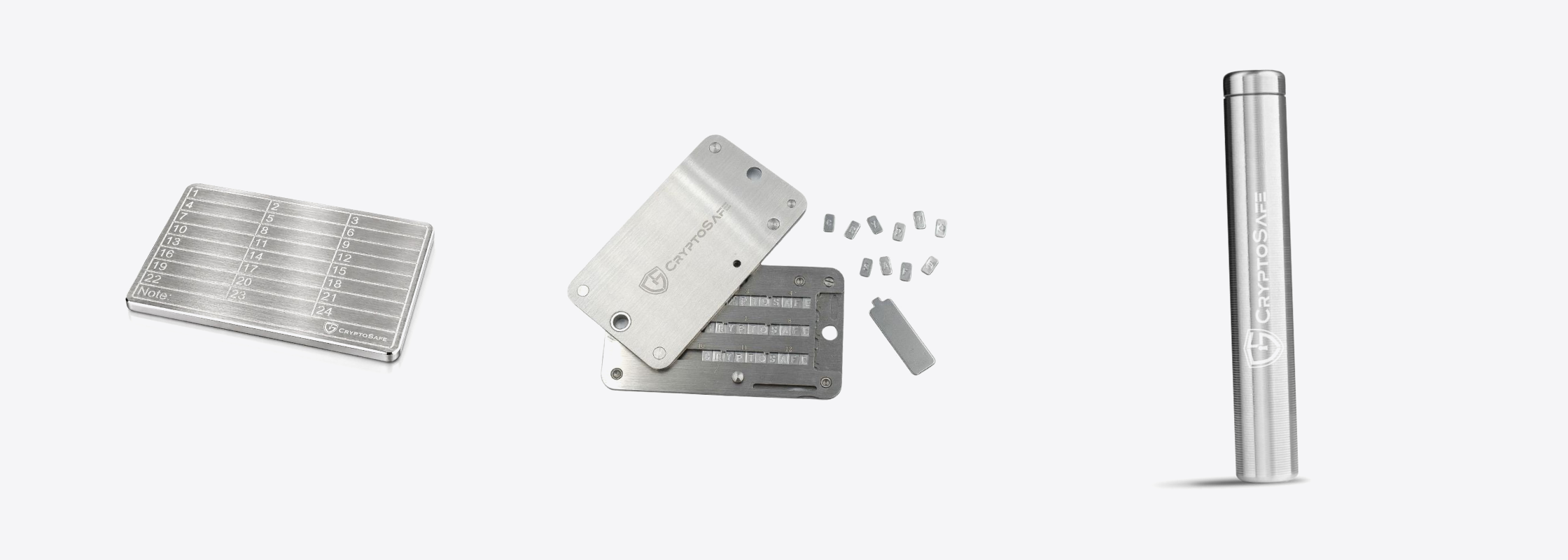
The direct fix is to move the words onto metal. A stainless steel plate with the letters stamped into it does not care about water or fire, and termites cannot eat it. It will outlast the device several times over.
There are two ways to get the words onto the steel. Stamp or engrave them yourself, which costs less but is unforgiving: a letter struck in the wrong place stays there. Or slot in pre-engraved tiles, which costs more, takes a few minutes, and lets you pull a wrong letter straight back out — and swap the whole phrase later if you move to a new wallet.
We have written about where to keep it, and about splitting it across locations, in our guide to storing a recovery phrase.

CryptoSafe
฿299
- Credit-card sized stainless steel, 86 x 54 mm
- Holds a full 24-word phrase
- Survives fire and water, and termites cannot eat it
Sets with a pen, stamp and hammer are on the product page

CryptoSafe
฿1,790
- Pre-engraved letter tiles slide in — no hammer, and a wrong one pulls back out
- Grade 316 stainless steel, 105 x 60 x 6 mm
- Takes anything from 12 to 24 words
Grade 316 is rated to hold up at 1,500°C for 10 to 12 hours

CryptoSafe
฿1,990
- Threaded stainless steel capsule
- Keeps water away from the plate inside
- Suited to burying or hiding away from the house
What is not a backup

A photo on your phone. The phone is online all the time, and photos are usually backed up to the cloud automatically without you asking. Your phrase is now on somebody else's server.
A file in cloud storage, or an email to yourself. Same reason, and an email account is one of the first things an attacker goes for.
A password manager. Safer than the two above, but it is still connected to the internet, and if the master password goes, the phrase goes with it.
Typing it into a computer for any reason at all, including to "check I copied it correctly". A keyboard is the easiest thing for malware to read, and this is precisely the step a hardware wallet exists to avoid.
Passphrase, and splitting the words
A passphrase is one extra word that you choose, added on top of the seed phrase. The result is a separate wallet. Someone who gets your 24 words but not the passphrase finds an empty wallet. The trade is that forgetting the passphrase locks you out too, and nobody can help. We have written up how to use it in our passphrase article.
Splitting the phrase is supported by some models: the phrase is divided into several shares with a threshold, so three shares in three places might restore from any two, and a single share that leaks means nothing on its own. It suits someone more worried about fire or flood than about theft. Which models do it is covered in our Trezor line-up comparison.
Both are things to adopt once you understand them, not on day one. If you are starting out, copy the phrase correctly and store it well. That is ninety percent of the job.
Common questions
What is the difference between 12 and 24 words?
The length of the underlying random value. Neither can realistically be guessed. Twenty-four words carries more theoretical margin; in real use your risk is a miscopied word and poor storage, not the length of the phrase.
Can I use the same phrase in a different brand of wallet?
In most cases yes, because 12- and 24-word phrases use the same BIP39 standard. That is exactly why you are not tied to one manufacturer. Split-share phrases use a different standard and do not always move between brands.
Do I need a metal plate, or is paper enough?
Paper is fine for day one, but not for ten years. If what you are protecting is worth many times the price of a plate, staying on paper is betting the larger amount to save the smaller one.
Does SIAMBC keep a copy of my phrase?
No, and we will never ask to see it. The phrase is generated inside your own device and never passes through us. Even if you wanted to tell us, you should not.
One rule to remember
- Anyone who asks for your seed phrase is a scammer. No exceptions.
- Neither SIAMBC nor any manufacturer will ever ask for it, whatever reason is given — warranty claims, identity verification, system updates or account recovery. Those words are the key to your funds. Whoever has them owns your crypto, and it can never be recovered.
SIAMBC has sold hardware wallets and seed phrase backups since 2016. Our Bangkok shop is open if you want to see them in person or ask us anything first, in Thai or English.

Share:
What is the Ledger Nano S Plus?
Quiz answers: win a Ledger Nano S Plus at Thailand Crypto Expo 2022