

In brief
- Thai MP Rangsiman Rome says relevant individuals and regulators will be invited to a parliamentary committee hearing on 7 October 2026.
- Questions centre on disclosed wealth and earlier business links involving Ren Protocol, Alameda Research, FTX and Three Arrows Capital.
- Ren's public relationship with Alameda and a creditor claim in the 3AC liquidation do not, by themselves, establish wrongdoing.
- MP Suchada Sang Tansap has rejected the allegations, requested evidence and said the facts should be tested through proper procedures.
- No public court judgment or regulatory finding currently establishes that Taiyang Zhang committed fraud or participated in a scam network.
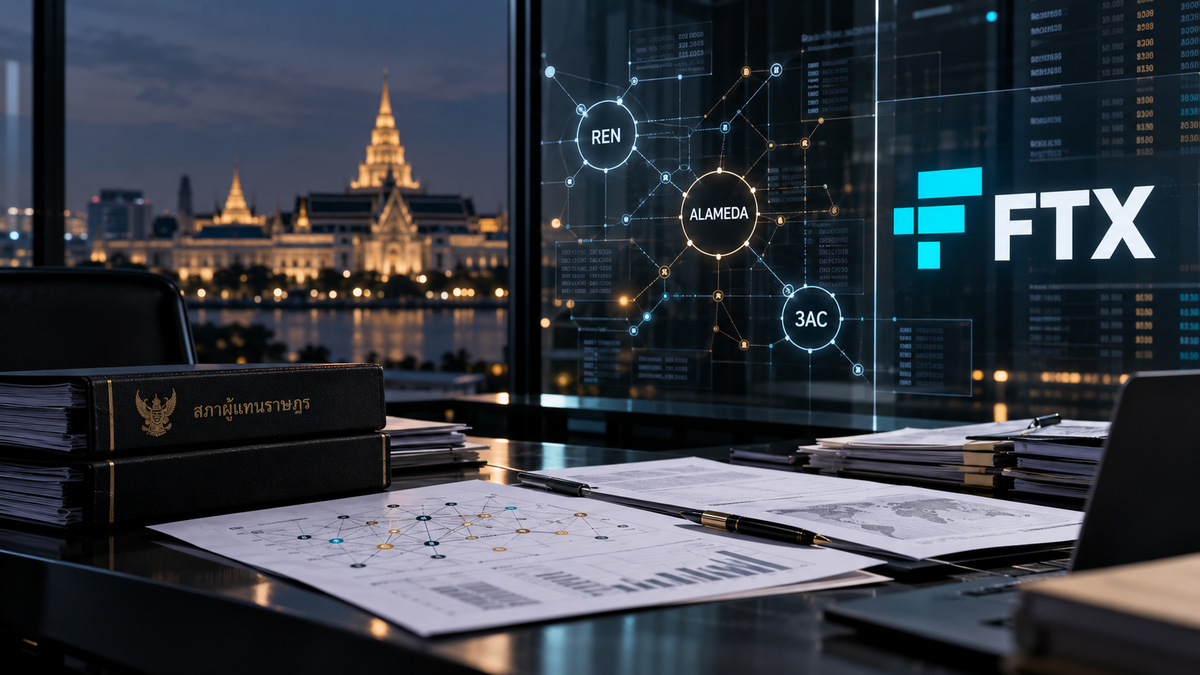
FTX is back in the Thai news cycle after a parliamentary debate raised questions about the assets and earlier crypto-industry activities of Taiyang Zhang, the husband of Chaiyaphum MP Suchada Sang Tansap. The discussion has drawn together several names associated with the 2022 crypto crisis: Ren Protocol, Alameda Research, FTX and Three Arrows Capital, commonly known as 3AC.
Those connections require careful language. A prior commercial relationship is not proof of a criminal offence, and a name appearing in liquidation records does not establish participation in the conduct that caused a company to fail. This article separates public business history from allegations that remain untested.
What happened in parliament
On 1 October 2026, People's Party list MP Rangsiman Rome called for scrutiny of Suchada and Zhang, referring to the scale of declared assets, Zhang's digital-asset background and financial dealings linked to overseas crypto businesses.
Rome later said the House Committee on Legal Affairs, Justice and Human Rights would invite the people concerned and representatives from the SEC Thailand, the Anti-Money Laundering Office and the National Anti-Corruption Commission to provide information on 7 October. That is an investigative step, not a finding of guilt.
Suchada has rejected the allegations, said that the comments damaged her family, asked Rome to disclose evidence and withdraw his remarks, and maintained that her asset declaration was filed according to law. She has also said she is prepared to establish the facts through the proper process.
Current status: these are allegations and questions awaiting examination. There is no public judgment or official finding that Zhang or Suchada committed an offence.
Zhang's reported crypto background
The name Taiyang Zhang is known in the digital-asset industry through Republic Protocol, which later became Ren Protocol. Ren developed infrastructure for moving value between blockchains, including ways to use assets such as Bitcoin across other networks.
Matching a name across company records, creditor documents and public profiles is only a starting point. A sound investigation still needs to confirm identity, corporate registration, dates, legal roles and the underlying documents before assigning legal meaning to any transaction.
How Ren, Alameda and FTX connect
In February 2021, the Ren development team publicly announced that it was joining Alameda Research and would work on integrations involving Solana and Serum. This was a disclosed commercial relationship established before Alameda and FTX collapsed in 2022.
Alameda was a trading and investment firm closely connected with FTX and Sam Bankman-Fried. FTX's bankruptcy exposed a broad network of investments, subsidiaries and counterparties. It is therefore unsurprising that companies which once dealt with Alameda appear in bankruptcy records.
Ren's relationship with Alameda is a matter of public business history. It does not make every Ren founder or employee responsible for the FTX fraud. Any claim about proceeds requires the acquisition agreement, payment records, recipient details and evidence of each person's role at the relevant time.
The 3AC creditor claim
Thai reports have also highlighted liquidation documents describing a claim in the name of Taiyang Zhang for approximately 44.55 million USDC, including principal and accrued interest, against failed hedge fund Three Arrows Capital. The claim was reportedly admitted as an unsecured debt.
A creditor is a party seeking repayment from the failed fund. That status does not show that the creditor managed 3AC or participated in the decisions that led to its collapse. The unresolved questions concern the origin of the loan, whether it had any connection to the Ren transaction, and whether the amounts reconcile with the relevant asset declarations. Timing alone cannot answer those questions.
Established facts and open questions
| Issue | Current position |
|---|---|
| Ren announced a relationship with Alameda in 2021 | Supported by a public Ren announcement |
| FTX and Alameda failed in 2022 | Established and subject to extensive legal proceedings |
| A 3AC claim reportedly carries Taiyang Zhang's name | Reported from liquidator material; the complete source documents remain important |
| The 3AC loan came from a Ren-related payment | Unproven; the public evidence does not yet establish a complete money trail |
| The people named were part of a scam network | An allegation, not an established fact |
| The asset declaration or transactions breached Thai law | Requires examination by competent authorities and a response from those concerned |
What happens next
- Committee evidence: the key question is who attends, what documents are produced and whether identity and fund-flow questions are answered.
- Original agreements: acquisition documents, 3AC loan records, repayments and asset declarations need to reconcile.
- Regulatory roles: Thailand's SEC, AMLO and NACC have different powers and information. Their decisions will determine what can be examined.
- Right of reply: everyone named must have a fair opportunity to explain the source of assets and present supporting records.
- No trial by transaction graph: blockchain data can trace transfers, but it cannot independently establish purpose, legal ownership or beneficial control.
Lessons for crypto holders
The story shows both the power and the limits of blockchain analysis. Transfers can remain visible for years, but corporate records, contracts, bank statements and signatory authority are still needed to explain what they mean.
For investors, the collapse of FTX and 3AC remains a reminder that institutional size does not remove counterparty risk. Funds needed for trading can remain on an exchange, while long-term holdings may be better separated and secured through a hardware wallet set up by the owner. Self-custody removes one intermediary but makes Seed Phrase protection and transaction verification the owner's responsibility.
Hardware wallets for long-term holdings
Choose hardware according to the phone or computer you use, the way you review transactions and the backup process you can manage confidently. Always test with a small transfer and keep the Seed Phrase offline.

Trezor
- Touchscreen transaction review
- Works with current devices including iPhone
- Open-source software design
This button selects Charcoal Black. Other editions are available on the product page.

Ledger
- Bluetooth phone connection
- Built-in battery for mobile use
- Broad app and asset support
This button selects Onyx Black. Check the product page for other colours.

Tangem
Tangem Ring + Tangem Wallet 2 Cards Set
- NFC connection to a phone
- Two backup cards included
- No battery or charging required
This button selects ring size US 7. Measure before ordering.

OneKey
- Large colour touchscreen
- Fingerprint authentication
- USB-C and wireless connectivity
This button selects Black. White is available on the product page.
FAQ
Has Taiyang Zhang been charged or found liable?
At the time of writing, no public Thai judgment or official finding establishes that Zhang committed an offence. The matter is at the allegation and inquiry stage.
Does an FTX connection prove participation in the fraud?
No. A commercial relationship, investment or appearance in bankruptcy material is not enough to establish liability. Individual roles, decisions and fund flows must be proved.
Did Alameda acquire Ren Protocol?
Ren publicly announced in 2021 that its development team was joining Alameda. Contract details, payment amounts and recipients require the original transaction records.
Is being a 3AC creditor illegal?
Not by itself. Lending and filing a creditor claim are financial activities. Any legal issue depends on the agreement, source of funds and applicable law.
Why does the case matter in Thailand?
It touches political asset disclosure, cross-border transactions and global crypto businesses. It will test how effectively Thai institutions combine blockchain evidence with legal and financial records.
Conclusion
The Ren, Alameda, FTX and 3AC links contain elements of verifiable business history, but the central questions about the source of funds, the relationship between transactions and the accuracy of asset declarations remain unresolved.
Responsible coverage should not turn a request for investigation into a verdict. Evidence should be disclosed and tested, the people named should receive a full right of reply, and readers should follow the committee record and official findings rather than treating the appearance of FTX in a headline as proof.

Share:
Flood Safety for Hardware Wallets and Seed Phrases: What to Do Before, During and After