

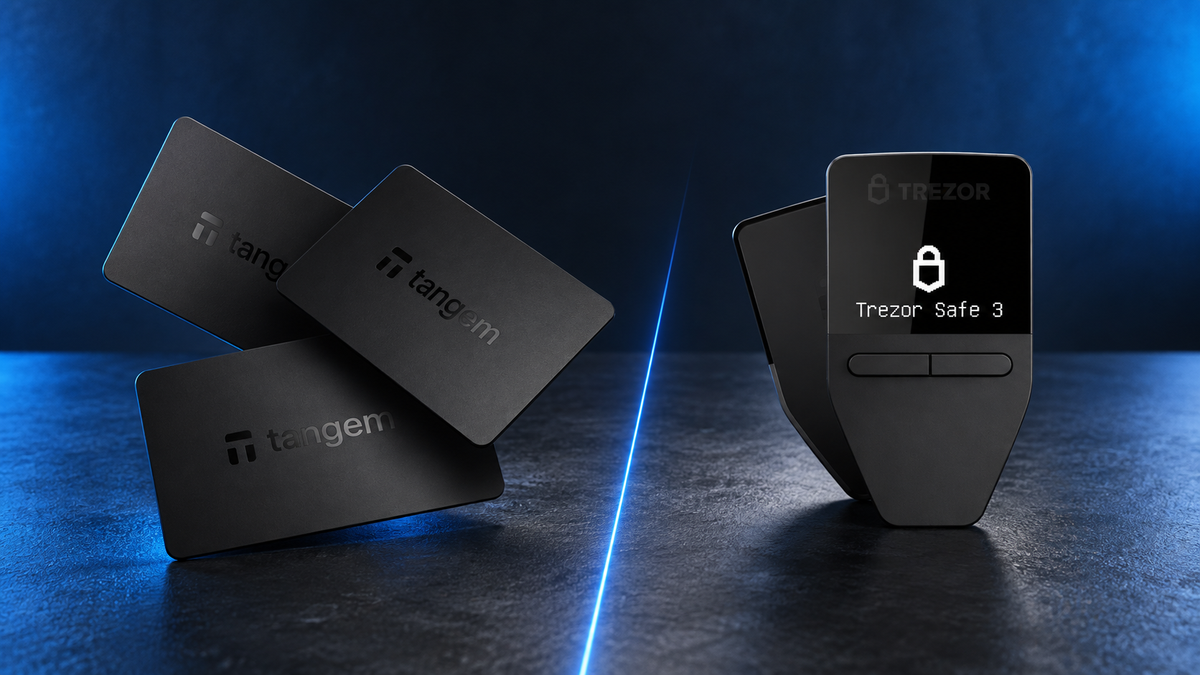
Tangem and Trezor both keep private keys away from everyday internet-connected devices, but they approach self-custody from opposite directions. Tangem turns the hardware wallet into a slim NFC card and uses your phone as the interface. Trezor gives you a dedicated screen and physical confirmation on the device itself. That difference shapes everything from daily use to backup planning.
The short answer
- Choose Tangem for a phone-first experience. It is cable-free, battery-free and easy to carry alongside your bank cards.
- Choose Trezor for independent on-device verification. Its screen lets you check transaction details away from the computer or phone that prepared the transfer.
- Tangem can be set up without a recovery phrase by backing the wallet up to multiple cards, or with a standard seed phrase if you want broader recovery options.
- Trezor supports standard BIP39 and SLIP39 backups, including multi-share recovery for users who do not want one backup to become a single point of failure.
- Our view: Tangem is the easier fit for frequent mobile use. For long-term storage, open-source transparency and a more conventional recovery plan, Trezor is the stronger all-round choice.
Two very different designs for the same job
Neither device stores your coins. Crypto remains recorded on its blockchain, while the hardware wallet protects the private keys required to authorize transactions. Both products aim to keep those keys out of reach of malware and remote attackers.
Tangem strips the hardware down to a secure element and an NFC antenna sealed inside a card. There is no display, battery, cable or charging port. You open the Tangem app, prepare an action and tap the card against your phone when a signature is required.
Trezor follows the traditional hardware-wallet model. A Trezor Safe 3 connects over USB-C and has its own OLED screen and two buttons. The companion app prepares the transaction, but the device displays the critical details and waits for physical confirmation.
What daily use feels like
Tangem is built around the phone in your pocket
If you already manage most of your finances on a smartphone, Tangem feels immediately familiar. There is no cable to find and no battery level to check. The card fits in a wallet, and the app handles portfolio views, receiving addresses, transfers and supported dApp connections.
Your phone must support NFC, and it helps to learn where the NFC antenna sits on your particular model. The card is the signing device, while the phone remains the screen and network connection.
Trezor adds a step for clearer separation
Trezor Suite leads users through authenticity checks, firmware installation, wallet backup and PIN creation. There are more steps than with a tap-based card, but each step makes the security model easier to see. When money moves, the final approval happens on the Trezor rather than only within the interface on your computer.
The Safe 3 is best suited to desktop use or a compatible Android device over USB-C. iPhone users who want a wireless Trezor experience should look at the Safe 7 rather than assume the Safe 3 works like an NFC card.
Why the screen matters
A hardware-wallet screen is a security tool. It provides a separate place to verify the destination address and amount before a private key signs anything. If malware changes an address on a computer, the device screen can reveal the mismatch.
Trezor provides that independent checkpoint. Tangem does not have a display, so transaction details are presented by the mobile app before the card is tapped to sign. The private key still remains inside Tangem's secure chip, and possession of the card plus the access code is required, but users should understand that they are relying on the phone for transaction display.
This is not a simple safe-versus-unsafe distinction. It is a choice between a minimal, mobile signing device and a device with a dedicated verification channel.
Backup and recovery work differently
Tangem without a seed phrase
In a seedless setup, the key is generated inside the first Tangem device and securely copied to the other cards during the one-time backup process. Every card in the set can access the same wallet. Lose one card and the others still work.
The trade-off is straightforward: if every card is lost or destroyed and no seed phrase exists, there is nothing else to restore. The cards should therefore be stored in separate places. You also cannot add another backup card later; moving to a fresh set requires creating a new wallet and transferring the assets.
Tangem with a seed phrase
Current Tangem hardware can also create or import a BIP39 recovery phrase. This gives users a recovery route beyond the original cards and makes migration to compatible wallets possible. It also reintroduces the main risk of seed-based wallets: anyone who obtains the words may be able to recover the wallet.
Trezor's standard and multi-share backups
Trezor supports 12-, 20- and 24-word wallet backups depending on the selected standard. Safe Family devices use a 20-word SLIP39 single-share backup by default and can move to a multi-share arrangement. Multi-share backup lets you create several recovery shares and choose how many are required to reconstruct the wallet.
This is a flexible long-term recovery model, but the backup must be kept offline and private. A Trezor can be replaced; a compromised recovery phrase requires an immediate move to a fresh wallet.
Plan for failure before funding the wallet: consider theft, fire, damaged phones, lost cards and family access in an emergency. The right backup is the one you can recover without leaving an easy path for someone else.
Security, secure elements and open-source design
Tangem uses an EAL6+ certified secure element. Keys are generated and held inside the chip, and the device firmware is installed once rather than updated later. Tangem's mobile app is open source, while the card firmware is closed and has been reviewed by independent security firms.
Trezor Safe 3 also uses an EAL6+ secure element, but Trezor's broader design philosophy is public verification. Its software, firmware and major hardware design elements are open source, allowing independent researchers to inspect, build and challenge the system.
Open source does not make a product invulnerable, and a certification level does not evaluate every part of a finished wallet. Trezor has the edge for buyers who want maximum transparency. Tangem appeals to those who prefer a fixed-function chip and a firmware design that cannot be changed after manufacture.
Tangem vs Trezor Safe 3 at a glance
| Feature | Tangem Wallet | Trezor Safe 3 |
|---|---|---|
| Form factor | NFC card with no screen or buttons | Dedicated device with OLED screen and two buttons |
| Connection | NFC on iOS and Android | USB-C on desktop and compatible Android devices |
| Battery | None | None |
| Transaction review | Shown in the phone app; tap card to sign | Shown and confirmed on the hardware wallet |
| Default backup approach | Two or three equal hardware devices | BIP39 or SLIP39 wallet backup |
| Seed phrase option | Optional on current-generation devices | Standard recovery method |
| Secure element | EAL6+ | EAL6+ |
| Transparency | Open-source app; closed, independently audited device firmware | Open-source software, firmware and core design |
| Best fit | Phone-first users who value portability | Long-term holders who value on-device review and transparency |
Which one should you buy?
Pick Tangem if your phone is your primary crypto device, you want the smallest possible learning curve and you like the idea of keeping multiple physical cards instead of managing a written recovery phrase. The three-card set offers more flexibility than the two-card set when one card is lost and an access code needs to be reset.
Pick Trezor if you want to verify transactions on a separate screen, prefer open-source hardware and software, or need a standard recovery plan that can be documented for long-term storage. Safe 3 is the value-focused choice; Safe 5 adds a touchscreen, while Safe 7 is designed for users who need wireless mobile connectivity.
SIAMBC recommendation
Tangem is the better convenience product. Trezor is the better fit when verifiability, an independent display and flexible recovery matter more than carrying the wallet every day. For a first long-term cold-storage wallet, we would generally choose Trezor Safe 3 after confirming that it supports the required assets.
Featured products

Tangem
THB 2,590
- Three devices for access and backup
- NFC support for iPhone and Android
- Seedless or seed-phrase setup

Trezor
THB 3,790
- EAL6+ secure element
- On-device screen and confirmation
- Open-source design with standard backups
Frequently asked questions
What happens if one Tangem card is lost?
The remaining backup cards continue to work. If the missing card could be used by someone who knows the access code, move the assets to a newly created wallet. A seedless Tangem wallet cannot be recovered if every card is gone.
Can a lost Trezor be replaced?
Yes. The wallet can be restored on a compatible device with the correct wallet backup. The recovery words should never be entered into a website, shared with support or stored as a photo.
Can Tangem be used on a computer?
Tangem is designed around its iOS and Android app and requires an NFC-capable phone. It does not provide the same cable-based desktop workflow as Trezor.
Which is better for Bitcoin-only storage?
Both can secure Bitcoin. Trezor Safe 3 has a Bitcoin-only Edition and an independent screen, making it our preferred option for transparent long-term Bitcoin storage. Tangem remains attractive when portability and phone access matter more.
Final verdict
Tangem makes self-custody feel as simple as using a contactless card. Trezor asks for a little more attention but gives users a dedicated screen, an open design and conventional recovery standards. Start with the device you actually use, the failure scenarios you need to survive and the backup method you can protect for years. Those questions matter more than a feature count.
Prices and compatibility were checked on 18 September 2026 and may change. Always confirm asset and network support before purchasing or transferring funds. Written by Bank.


Share:
CLARITY Act Stalls in the Senate: Why Bitcoin and the Crypto Market Fell