
In brief
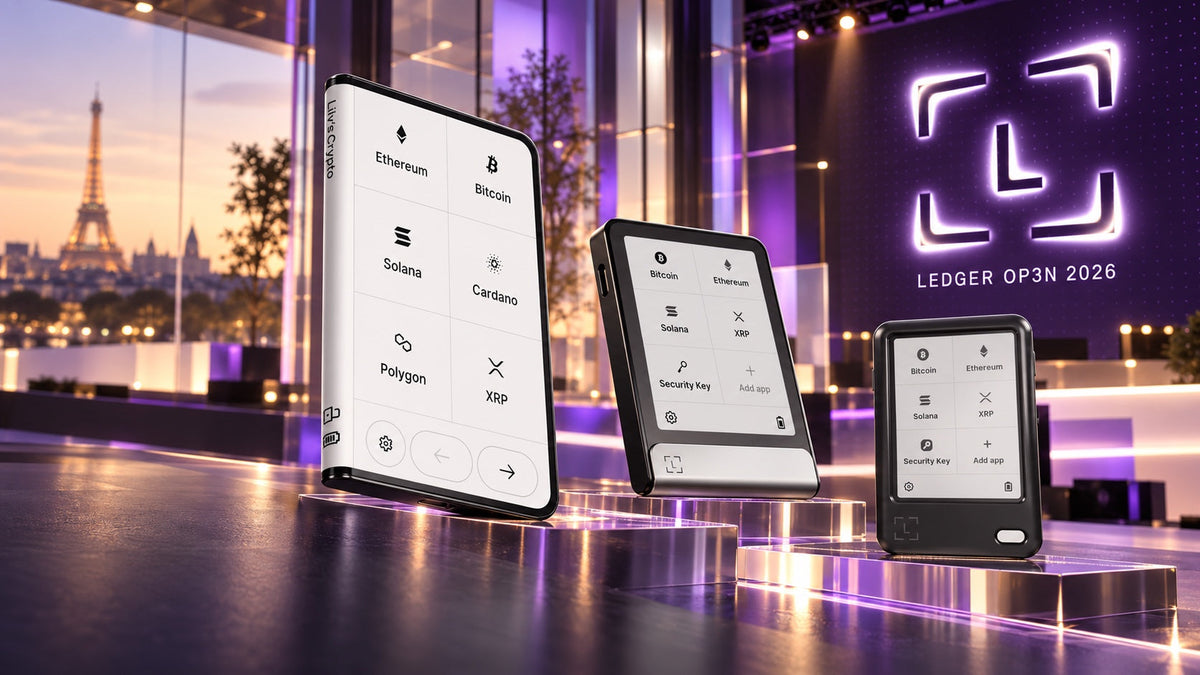
Ledger Op3n 2026 takes place in Paris on October 15, 2026. Ledger is framing this year's event around the convergence of AI, blockchain and quantum computing, with keynotes, company announcements, product reveals and live demonstrations. Anyone unable to attend in person can register for the official livestream.
Digital ownership is entering a new phase. AI agents can already search, compare, book and prepare actions on a user's behalf. The harder question is what should happen when an automated system reaches an irreversible financial decision. Convenience is useful, but it should not quietly replace the owner's final authority.
That tension is central to Ledger Op3n 2026. Rather than treating a hardware wallet as a passive vault, the event is expected to explore its role as a trusted approval point between intelligent software and a user's digital assets, identity and communications.
What is Ledger Op3n 2026?
Ledger Op3n brings together founders, builders, investors, creators and security specialists. The 2026 edition will be held in Paris on October 15, 2026, with keynotes, major announcements, product reveals and live demonstrations on the programme.
Some details are being held for the event itself. It is therefore worth separating confirmed information from speculation: Ledger has confirmed the date, format and broad focus, but any unannounced product specifications should be treated as rumours until the company presents them.
Why AI, blockchain and quantum matter
Each technology changes the security model in a different way. Blockchain gives people direct control over transferable digital assets. AI lets software prepare increasingly complex actions. Quantum computing is forcing the security industry to consider how today's cryptography may need to evolve over time.
| Technology | What changes | The security question |
|---|---|---|
| AI agents | Software can plan and initiate actions for a user | How do we stop a mistaken or manipulated instruction? |
| Blockchain | Ownership and transactions live on public networks | How does the owner verify the destination and protect private keys? |
| Quantum computing | New computing capabilities may challenge some cryptographic systems in the future | How early should devices and standards prepare for migration? |
The practical goal is not to label one technology as safe and another as dangerous. It is to design systems where automation can assist without taking final control away from the owner. A hardware signer can provide that separation by keeping private keys away from general-purpose computers and requiring a deliberate confirmation on a trusted display.
Why human approval becomes more important
An AI system can help compose a transaction or explain its purpose, but it should not receive unlimited authority to move assets. A well-designed hardware wallet acts as a final checkpoint: it displays critical transaction data independently and asks the owner to approve only after reviewing it.
Never approve a transaction only because an AI assistant or computer screen recommends it. Verify the network, destination address, amount and smart-contract permissions on the hardware wallet itself. Cancel the request if the details differ or are unclear.
This separation matters even more when an AI agent is connected to email, browsers, exchanges and payment services at the same time. A single compromised input can otherwise travel quickly through an automated workflow. Preparing an action and authorising it should remain two distinct steps.
What to watch during Ledger Op3n 2026
| Area | What to look for | Why it matters |
|---|---|---|
| Announcements and product reveals | Confirmed device formats, features and availability | Official details separate facts from leaks and speculation |
| Live demonstrations | Real workflows, screen clarity and confirmation steps | Usability affects whether people notice a malicious request |
| AI and human approval | How AI agents and private-key owners divide responsibility | Automation must not become ownership |
| Quantum security | Plans for devices, software and cryptographic migration | Security transitions need preparation before risk becomes urgent |
| Digital identity | Hardware-backed approval for identity, documents and communications | A secure signer may have uses beyond holding crypto |
Product launches should still be assessed after the presentation. Look for technical documentation, compatibility lists, recovery design and independent review before deciding whether an upgrade is useful.
How to follow Ledger Op3n
People in Paris can request access through the Ledger Op3n registration page. Viewers elsewhere can register for the official livestream. Check the schedule again close to the event because session times may be updated.
- Save October 15, 2026 in your calendar.
- Register through Ledger's own channels.
- Ignore accounts offering token giveaways or asking you to connect a wallet to watch.
- Never enter a recovery phrase, PIN or passphrase for event access.
- Wait for official compatibility and availability details before ordering a newly announced device.
What hardware wallet users should assess after the event
The number of new features matters less than whether those features make verification easier. Users should examine what appears on the trusted display, how much access companion software receives and whether recovery remains under the owner's control.
- Check support for existing devices: a new announcement does not automatically make current Ledger devices obsolete.
- Read release notes before updating: confirm that your recovery phrase backup is available and use software obtained directly from Ledger.
- Separate essential features from optional services: enable only functions you understand and intend to use.
- Keep verifying on-device: more automation does not remove the owner's responsibility to inspect the final request.
Choose a Ledger device for the way you work
You do not need to wait for an unannounced product to secure private keys. Ledger's current range covers compact Bluetooth devices as well as larger E Ink touchscreens designed to make transaction details easier to review.

Ledger
- Compact and easy to carry
- Bluetooth and USB-C connectivity
- Works with iPhone, Android and computers
This button selects Onyx Black, currently available from SIAMBC.

Ledger
- 2.8-inch E Ink touchscreen
- Bluetooth, USB-C and NFC
- Compatible with iPhone and Android
This button selects Jet Black. Other colours can be chosen on the product page.

Ledger
- Clear E Ink touchscreen
- Aluminium frame and Gorilla Glass
- Works with iPhone, Android and computers
This button selects Black Graphite. Other colours are available on the product page.

Ledger
- 3.7-inch curved E Ink touchscreen
- Bluetooth, NFC and wireless charging
- Flagship model with Ledger's largest display
Ledger Stax in Graphite with the included items shown on the product page.
Frequently asked questions
When is Ledger Op3n 2026?
The event takes place in Paris on October 15, 2026. International viewers can register for Ledger's official livestream.
What will Ledger launch at the event?
Ledger has confirmed announcements, product reveals and live demos, but product specifications should not be treated as final until they are presented officially.
Do I need to connect a wallet to watch?
You should never need to reveal a recovery phrase or approve a transaction to watch an event stream. Close any page that asks for secret information or claims you must connect a wallet for a giveaway.
Will current Ledger devices stop working?
The event announcement does not imply that. Existing devices should continue to work according to Ledger's software and firmware support. Check official compatibility information after the event.
Should I buy now or wait?
Current Ledger models already provide secure private-key storage. Waiting may suit people who are in no hurry and want to see the announcements first. Choose based on your phone or computer, preferred screen size and connectivity rather than rumours.
Conclusion
Ledger Op3n 2026 matters because hardware wallets are becoming more than cold-storage devices. As AI takes on more tasks, a trusted screen and deliberate human approval may become even more important. Whatever Ledger announces on October 15, the core habits remain the same: control your recovery phrase, verify transaction details on the device and never approve a request you do not understand.
Written by Bank. Updated October 4, 2026.

Share:
Taiyang Zhang, Ren, Alameda, FTX and 3AC: What Is Known and What Still Needs Proof