

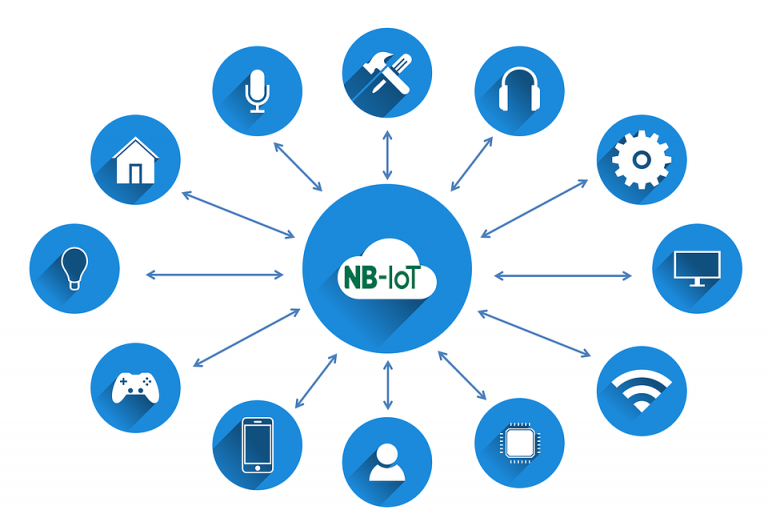
Narrowband Internet of Things, abbreviated NB-IoT, is a low-power wide-area network (LPWAN) technology developed to connect devices anywhere at any time. With that capability, NB-IoT is deployed in controlled areas, in places hard to reach at a distance from the nearest mobile base station, or in dense areas where a signal struggles to penetrate, such as tall buildings or underground.
Where the signal is obstructed in the situations above, transmission capability drops, and it becomes necessary to rely on transmitting equipment working with network systems that use high power and consume battery heavily. Beyond that, mobile networks cannot be used appropriately for applications that send small amounts of data infrequently. And the mobile cellular standards we use today, such as 3G, 4G or 5G in future, cannot support power-saving devices the way NB-IoT can, which makes those cellular standards unsuitable for cheap devices that need a battery lasting several years.
NB-IoT can connect a great many devices to the internet and make new applications genuinely usable. It suits applications that need to communicate through small data signals over long periods. Because NB-IoT operates on licensed frequency bands, we can be confident of both security and reliability, along with a guaranteed quality of service.
Using mobile signal bands for ordinary NB-IoT applications would be too expensive, and NB-IoT applications would not work at full efficiency. NB-IoT applications focus on transferring dense data at slow speed, which suits the capability of the devices. Cheap devices with a long service life can cut operating costs and reduce the risk of theft.
The main characteristics of NB-IoT
- Low power consumption (over 10 years on a single battery charge)
- Excellent extended signal range inside buildings and underground
- Easily installed on existing mobile base station sites
- A secure and reliable network
- Low component cost
The main applications of NB-IoT
Smart metering
NB-IoT suits measuring gas volumes and water levels through ordinary and small data transmitters. Network coverage is fundamental to how a smart metering system works, and the metering devices can take readings in difficult locations, such as mobile base stations, deep in basements, or in controlled rural areas — places NB-IoT can cover and penetrate.
Smart city
NB-IoT can help local authorities control street lighting, send an alert when a bin needs emptying, find free parking spaces, monitor environmental conditions and monitor road conditions.
Smart building
Sensors connected to NB-IoT can signal that a building is due for maintenance, and be used in automated systems such as lighting and heating control. NB-IoT can also serve as a backup broadband connection for a building. Some security systems may still need an LPWAN network to connect sensors directly to the metering system, since decommissioning them is harder than installing them.

Share:
How to spot a tampered hardware wallet
Examples of IoT technology in the age of Agriculture 4.0