

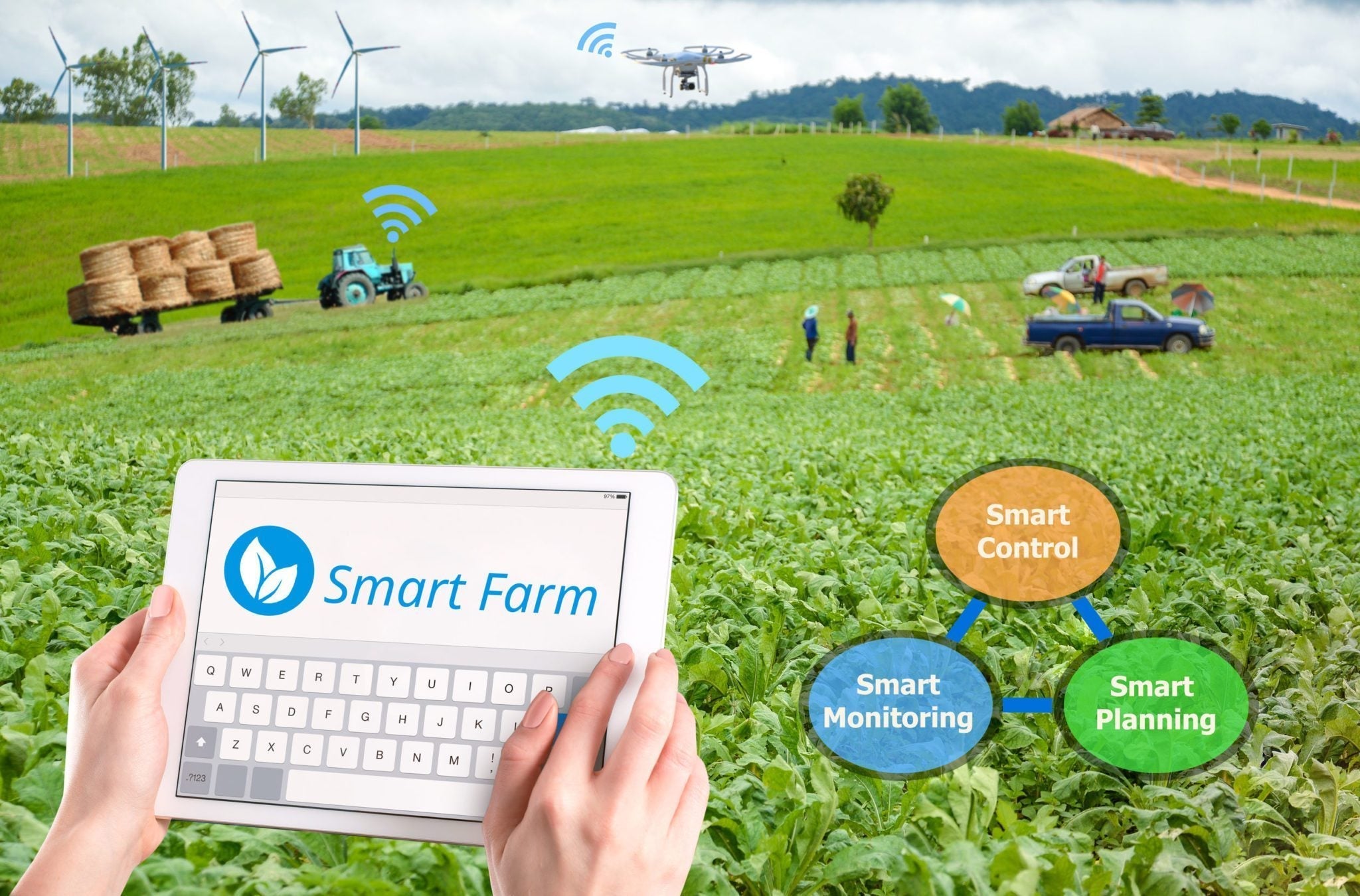
The Internet of Things (IoT) counts as a factor influencing the world we live in across a number of areas. Advanced industry, vehicles and communications technology, and smart cities are all part of IoT — as is applying technology such as IoT in the agriculture industry. The world's population is forecast to rise to 9.6 billion by 2050, so in order to meet the needs of that enormous population, agriculture will have to adapt to the age of Agriculture 4.0, whether in terms of challenges such as weather volatility and a changing climate, or the environmental impact arising from more intensive agricultural practice needed to cope with the world's continually rising demand for food. Smart farming using IoT technology — what in Thailand is familiarly called Agriculture 4.0 — will help Thai growers and farmers reduce waste and raise yields, from the amount of fertiliser used through to transporting produce off the farm. So what is Agriculture 4.0?
Agriculture 4.0 is an advanced agricultural system for producing clean and sustainable food for the world's population through intensive use of highly precise machinery, integrating modern ICT — information and communications technology — with the agricultural sector. Smart farm technology using IoT means building a system to inspect and monitor a growing area by making use of sensors (light, humidity, temperature, soil moisture and so on), as well as designing automated irrigation. Farmers can therefore check the condition of their growing area at any time, wherever they happen to be.
Agriculture 4.0 using IoT technology is therefore far more efficient than traditional farming. Applying smart farm technology is not aimed only at general operations or large-scale farming, but is also a new agricultural approach that will help raise the standard of growing practices or other common agricultural approaches — organic farming, family farming (complex or small plots, cattle and buffalo and other livestock, conserving particular breeds or high-quality breeds), and so on — and it helps make the agriculture industry more transparent. On environmental questions, a smart farm using IoT has a number of benefits, such as more efficient water use, or improving the efficiency of inputs and looking after produce.
Applying IoT in the age of Agriculture 4.0
Precision farming
The idea of precision agriculture, or precision farming, is one that helps promote and control agricultural operations so that they are more precise, particularly in raising livestock and growing crops. The important components of this farm management approach include applying IT and various devices — sensors, control systems, robots, autonomous vehicles, smart hardware, fertiliser, water and pesticide technology, and a great deal more. High-speed internet, mobile phones and low-cost but highly accurate satellites (for imaging and positioning) that producers have taken up also count as important technologies supporting the idea of Agriculture 4.0, which is one of the best-known applications of IoT in the agricultural sector, and a great many organisations worldwide are making use of it.
Share:
What is NB-IoT, and how will it change farming and business?
What is IoT? A simple explanation