


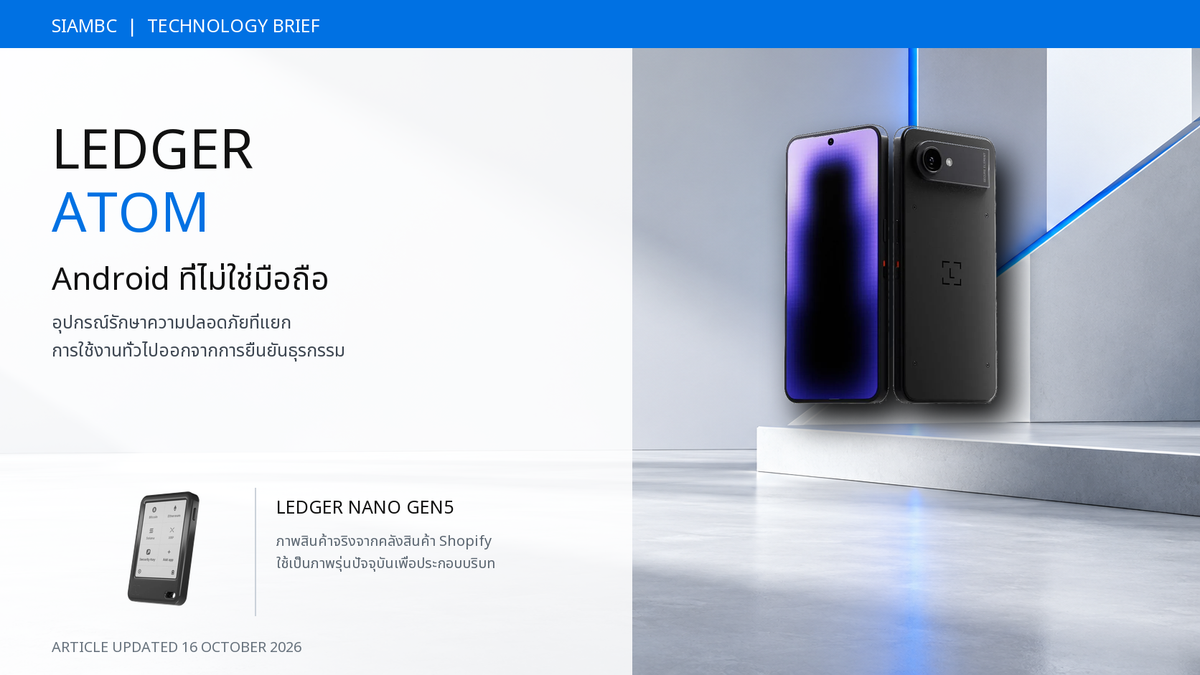
Ledger Atom looks like a smartphone, runs Android, and connects over mobile data. Yet Ledger is deliberately not calling it a phone. Atom is designed as a personal security device: Android handles everyday apps, while a separate Secure Element running Ledger OS protects keys and takes control when a sensitive action needs approval.
That makes Atom less about replacing the device in your pocket and more about creating a trustworthy place to approve transactions, identities, messages, and future AI-driven actions.
Key takeaways
- Atom runs Android for everyday use and Ledger OS on a separate Secure Element for protected operations.
- Its data-only eSIM supports 4G/5G, but not cellular calls, SMS, or emergency calling.
- Dedicated hardware hands the display and touchscreen to Ledger OS in Secure Mode.
- A circuit-level privacy switch disconnects the camera and microphone, and the battery is user-replaceable.
- Ledger is targeting 2027 delivery, but the device remains in development and details may change.
What Ledger Atom is
Atom is Ledger’s attempt to expand secure hardware beyond the familiar wallet form factor. It has a 6.77-inch OLED display, a Qualcomm Dragonwing processor, Android, a camera, and a 4,000mAh battery. The crucial distinction is that private keys and signing do not rely on the Android environment. Those operations remain inside a separate Secure Element running Ledger OS.
Ledger describes Atom as a security and privacy device. The aim is to give users a larger, connected interface without asking them to trust Android with the final approval step.
Why it is not a phone
Atom has a data-only eSIM and can connect to 4G and 5G networks, but it cannot make cellular calls, send SMS messages, or place emergency calls. Ledger says it is intended to work alongside a phone, not replace one.
That boundary matters. Atom is connected enough to run apps and receive requests, while reserving its most trusted environment for review and confirmation.
The phone-like shape is not the core feature. Atom’s real proposition is a hardware-enforced boundary between a general-purpose operating system and the environment that holds keys and approves sensitive actions.
How Android and Ledger OS stay separate
In Standard Mode, Android controls the display and touchscreen. When a protected action begins, custom hardware switches those components to Ledger OS in Secure Mode. Ledger says this is a physical separation rather than an app simply drawing over Android.
Keys and signatures remain inside the Secure Element, which Ledger identifies as an ST54M chip with Common Criteria EAL6+ certification. Atom also supports Genuine Check, allowing a second device to verify the Atom’s cryptographic attestation.
What Atom is built to do
- Digital assets: Ledger Wallet runs directly on Atom, with sensitive approvals handled in Secure Mode.
- Passkeys: credentials can be isolated from Android and used for secure authentication.
- AI agents: software agents may prepare actions, but protected steps still require physical confirmation.
- Encrypted messaging: two Atom users can exchange messages through Android apps and decrypt them inside Ledger OS.
- Privacy controls: a physical switch cuts power or connectivity to the camera and microphone at circuit level.
These ambitions are broader than a conventional hardware wallet. Their practical value will depend on the final software, supported services, and how smoothly users can move between the two modes.
Anti-tampering after CryptoBilis
Atom arrives while Ledger is responding to the CryptoBilis incident. Ledger says at least one affected device contained an unauthorized hardware implant that captured a recovery phrase during setup. The company characterizes the confirmed event as a localized distribution attack, not a compromise of Ledger’s Secure Element, operating systems, or central services.
For Atom, Ledger describes a protective enclosure around the Secure Element, MCU, and FPGA that is intended to detect drilling or opening. The device also monitors display and back-cover removal, pairs the rear cover to the unit, and uses tamper-evident packaging.
Those controls add meaningful layers, but no device should be treated as invulnerable. Source, storage, setup, and careful review of every approval remain part of the security model.
Specifications, price, and timing
| Area | Announced detail | Context |
|---|---|---|
| Display | 6.77-inch OLED, 60Hz | Designed for detailed review and app use |
| Architecture | Android plus Ledger OS on a separate Secure Element | Display and touch switch to Secure Mode for protected actions |
| Connectivity | Data-only 4G/5G eSIM | No cellular calling or SMS |
| Battery | 4,000mAh, user-replaceable | Ledger promises at least seven years of spare-parts support |
| Software support | Five years of Android updates | Based on Ledger’s announced roadmap |
| Price | $849 Founder’s Edition, then $899 | A refundable $100 deposit is required to reserve |
| Estimated delivery | Q2 2027 | Development is ongoing; timing and specifications may change |
What buyers should consider
SIAMBC does not currently list Ledger Atom for sale. A reservation placed with Ledger is not the same as buying ready stock in Thailand, so prospective buyers should review deposit terms, taxes, warranty arrangements, and the latest delivery estimate on Ledger’s official page.
Atom may appeal to users who want a dedicated approval environment for assets, passkeys, communications, and agent-driven workflows. Users who mainly need a compact signer for holding assets and confirming transactions may still be better served by Ledger’s existing devices.
Sources
- The Verge: Ledger’s new hardware wallet is an Android phone without the phone
- Ledger Academy: Introducing Ledger Atom
- Ledger: Introducing Ledger Atom
- Ledger Atom Technical Whitepaper
- Ledger: Response to the Hardware Implant Attack
This article reflects information available on October 16, 2026. Atom remains in development, and its specifications, price, and delivery schedule may change. This material is for technology education, not financial advice.


Share:
Ledger Op3n 2026: Why Secure Hardware Matters After the CryptoBilis Incident