

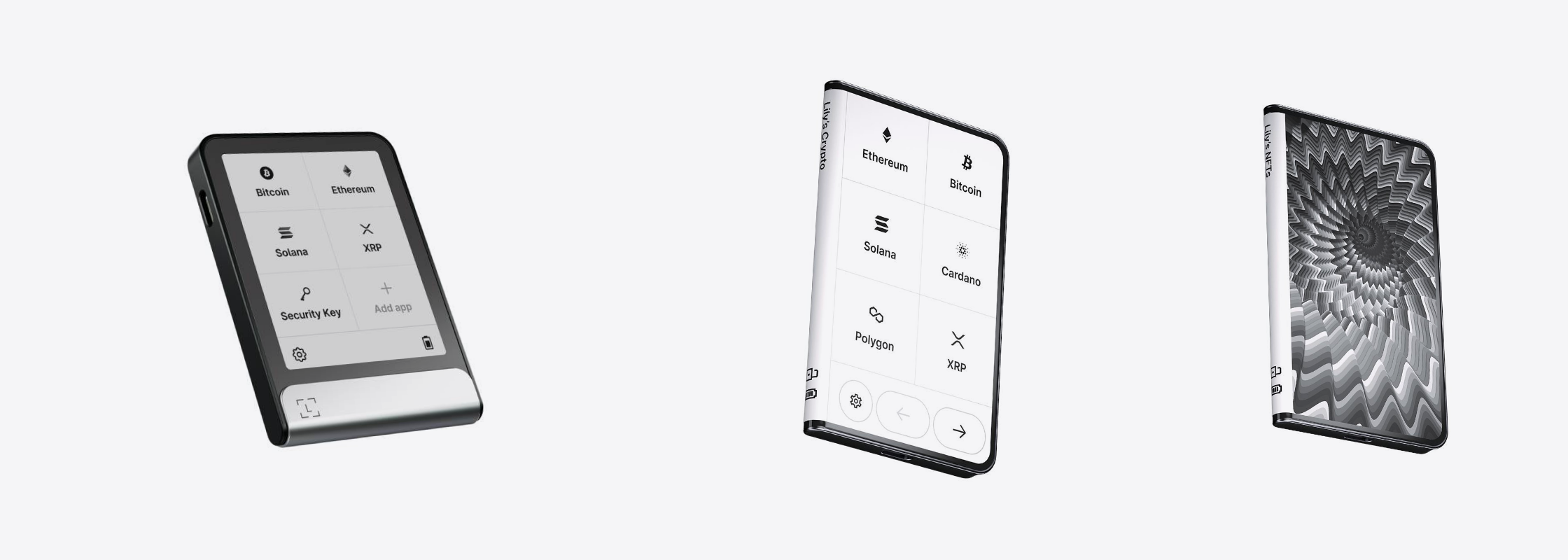
Key facts
- They are identical on security. Same ST33K1M5 secure element, same CC EAL6+ chip-level certification, same Ledger OS, and on both the touchscreen is driven directly by the secure element rather than through the MCU.
- The screen is the real difference. The Stax is 3.7 inches and curves around the spine; the Flex is 2.8 inches and flat. A bigger screen means a full address on one line when you confirm.
- Wireless charging and stacking are Stax-only. The Flex charges by USB-C cable. It has magnets, but Ledger scopes them to holding accessories — Flex units do not stack.
- The Flex is the tougher object, and the one with a choice of finish. Gorilla Glass front against the Stax's plastic, and several colors against the Stax's one.
- Both take a Ledger Recovery Key, and the Stax box includes one along with a Magnet Shell.
Everything that is the same

The worry people bring to this comparison is whether the cheaper one is less safe. It is not.
The Flex and the Stax use the same secure element, an STMicroelectronics ST33K1M5, certified CC EAL6+ at chip level. Same Ledger OS, same clear signing and Transaction Check, same Bluetooth Low Energy 5.2 and the same NFC.
There is one shared detail worth more attention than it usually gets. On both devices the touchscreen is driven directly by the secure element, not through the communications chip as in the Nano architecture. What you read on screen before approving comes from the same chip that holds your keys.
So security is not a variable here. Everything that remains is about living with the device.
The screen is what the money buys

The Stax has a 3.7-inch E Ink screen that curves around the spine of the device — Ledger calls it the world's first curved E Ink touchscreen. The Flex has a flat 2.8-inch E Ink screen.
This is not only a matter of looks. Everything security-relevant on a hardware wallet happens on the screen: you read the destination address and the amount, then you sign. A panel roughly a third larger means a full address on one line and more of the transaction visible without scrolling.
E Ink also holds an image with the device off. Both models can keep a picture or an NFT on the screen while idle. It is not an always-on display in the backlit sense; it is E Ink keeping what was last drawn without drawing power to do it.
Charging and magnets
The Stax charges wirelessly over Qi. The Flex does not. The Flex charges by USB-C cable only. This is the single most commonly mis-stated fact about the pair, because the Flex has both NFC and magnets and people reasonably assume charging follows.
The magnets also do different jobs. On the Stax they let devices stack, and hold the Magnet Shell. On the Flex they hold screen protectors and accessories. Two Flex units do not stack.
Stacking is not a gimmick. If you separate funds across several devices, or look after a household's or a company's wallets, keeping them as one stack is a real reason to choose the Stax.
Materials and finish
The Flex has a Gorilla Glass front with an anti-glare coating. The Stax uses a lightweight plastic cover, also anti-glare. For a device that lives in a bag and sometimes lands face down, glass takes scratches better than plastic.
Finish is the other clear split. The Flex we stock comes in 6 colors; the Stax comes in one. If how it looks matters to you, this is a Flex advantage the Stax cannot answer.
Some of the Flex metallics were launched by Ledger as limited editions. If you want a particular one, check stock before setting your heart on it.
Side by side
| Model | Ledger Flex | Ledger Stax |
|---|---|---|
| Screen | 2.8in, flat | 3.7in, curved |
| Resolution | 480 x 600 | 400 x 670 |
| Screen cover | Gorilla Glass | Plastic |
| Secure element | ST33K1M5 | ST33K1M5 |
| Chip certification | CC EAL6+ | CC EAL6+ |
| Connectivity | USB-C, Bluetooth, NFC | USB-C, Bluetooth, NFC |
| Wireless charging | No | Yes, Qi |
| Magnets | Holds accessories | Stacks |
| Colors | 6 finishes | One |
| Ledger Recovery Key | Works | Works, and in the box |
| Price | ฿10,480 | ฿16,800 |
Which one to buy
Choose the Flex if you want the tougher object, a choice of color, and to spend less. You get the same security chip as the flagship, a glass front, and a meaningfully lower price.

Trezor
฿10,480
- ST33K1M5 secure element, CC EAL6+
- 2.8in flat E Ink, Gorilla Glass front
- USB-C, Bluetooth 5.2 and NFC
- 6 finishes to choose from
Pick a color on the product page
Choose the Stax if the bigger screen, wireless charging or stacking is worth it to you. The 3.7-inch panel genuinely is easier to check a transaction on, and the box includes a Recovery Key and a Magnet Shell.

Trezor
฿16,800
- The same secure element as the Flex
- 3.7in curved E Ink screen
- Qi wireless charging, and it stacks
- Recovery Key and Magnet Shell in the box
Things to know first
EAL6+ certifies the chip, not the whole device. It applies to the secure element. A shop that tells you the device is EAL6+ certified is claiming more than the manufacturer does.
The Flex does not charge wirelessly. Repeated because it is the most commonly mis-stated fact about these two, and the kind of thing you would rather not discover after opening the box.
Do not carry the Stax battery figure across to the Flex. Ledger prints "up to 10 hours" in both columns of its own comparison table despite the very different screens, so we publish no runtime for the Flex.
The Ledger Recovery Key does not work with a Nano X or a Nano S Plus. Neither has NFC. Beyond the Flex and Stax there are newer models that do work with it, and Ledger's own pages disagree on the list — ask us before pairing one with another model.
A Recovery Key is not a replacement for writing your phrase down. It is a way of storing your recovery phrase on an NFC card. It does not remove your responsibility for that phrase.
Common questions
Is the cheaper one less secure?
No. Both use the same ST33K1M5 secure element, certified CC EAL6+ at chip level, and the same Ledger OS. The price difference buys screen, wireless charging and materials.
Can the Flex charge wirelessly?
No. It charges by USB-C cable. Qi wireless charging is on the Stax only.
Do I need to buy a Recovery Key separately with a Flex?
The Stax box includes one. For the Flex it depends on the production batch, so message us before ordering and we will check what is physically in stock.
Do they work with an iPhone?
Yes, both. They have Bluetooth, so they work with an iPhone as well as Android — unlike the Ledger Nano S Plus, which is USB-C only and does not work with iOS.
One rule to remember
- Anyone who asks for your 24-word recovery phrase is a scammer. No exceptions.
- Neither SIAMBC nor Ledger will ever ask for it, whatever reason is given — warranty claims, identity verification, system updates or account recovery. Those words are the key to your funds. Whoever has them owns your crypto, and it can never be recovered.
SIAMBC is an authorized Ledger reseller in Thailand and has sold security hardware since 2016. Our Bangkok shop is open if you want to handle both devices before choosing, or ask us anything first, in Thai or English.
Share:
Which Trezor should you buy? All five models compared